




- Published on: 2026-07-29 10:01:16
2026 Precision Guide: Moving Averages & Market Momentum
What if the indicators you have been told are "lagging" are actually the most precise roadmap to institutional capital? Most retail traders lose because they are paralyzed by too many signals or enter positions long after the smart money has already moved. Stop chasing ghosts in the noise. By using moving averages to trade with a refined, 2026-ready strategy, you transform these basic lines into the definitive footprints of global momentum.
You likely know the frustration of getting stopped out by a minor price wick only to see the trend continue without you. It is a common struggle that stems from a lack of clarity and timing. This guide promises to solve that by providing a repeatable trading framework designed for high-probability entries. We will show you how to leverage the 55 to 60 percent win rates seen in recent EMA backtesting and master the practical application of SMA versus EMA in live market conditions.
We are moving past basic definitions to deliver institutional-grade execution. You will gain the confidence to hold your winners and the technical edge to ignore the static. From the 200-day benchmark to high-velocity intraday setups, this is your blueprint for market dominance.
Key Takeaways
- Understand how moving averages function as a dynamic baseline for price action and why they exert a psychological "gravity" on institutional players.
- Master a high-probability blueprint for using moving averages to trade by combining the 200-period SMA for trend direction with dual-MA systems for entry signals.
- Learn to select the elite tool for your specific objectives, distinguishing between the long-term stability of the SMA and the high-speed responsiveness of the EMA.
- Identify "invisible" floors and ceilings in the market by treating moving averages as dynamic support and resistance levels that move in real-time.
- Boost your execution efficiency by matching your chosen MA strategy to the optimal account tier, from the Rookie account for testing to the high-performance Scalp account.
Mastering Market Momentum: Why Moving Averages are the Trader's Essential Filter
Markets are chaotic, but they aren't random. A Moving average acts as a dynamic baseline, cutting through the volatility to reveal where the real money is moving. This isn't just math. It's a map of psychological gravity. When price deviates too far from the average, it eventually snaps back. Retail traders often ignore this tension. Institutional players use it to anchor their entries. They understand that the average represents the collective consensus of value over a specific window.
The Core Purpose: Smoothing the Noise
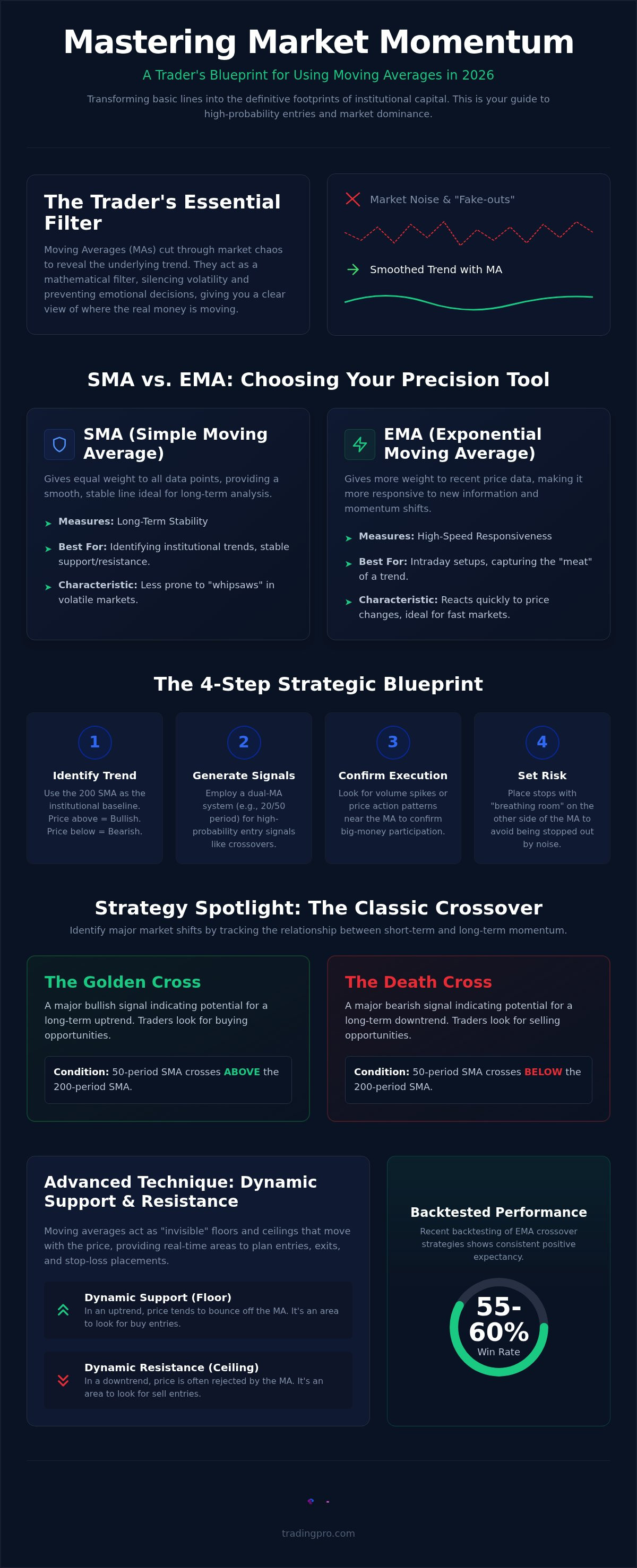
Market chatter is the enemy of profit. It creates "fake-outs" that trigger emotional decisions and lead to unnecessary losses. A Moving Average is a mathematical filter of historical price data used to identify trend direction. It silences the noise. By focusing on the smoothed line rather than every tick, you gain a clear view of the underlying trend. The choice of timeframe is critical. Short-term averages offer high sensitivity for aggressive moves. Long-term averages provide institutional-grade stability. Finding your balance is the first step in using moving averages to trade with precision.
Lag vs. Confirmation: Reframing the Narrative
Critics call moving averages "lagging" indicators. They are right. That is exactly why they work. Lag is a safety mechanism. It protects you from jumping into every minor price flicker. It forces you to wait for price action to confirm a structural shift before you commit capital. It's better to be right than first. In high-stakes environments, being "first" often means being the liquidity for someone else's exit. Using moving averages to trade allows you to follow institutional footprints rather than guessing where they might lead.
While the indicator lags, your execution shouldn't. TradingPRO's institutional-grade execution speed ensures that once your MA signal confirms, you enter the market without friction. This minimizes the gap between the signal and the fill. It turns "lag" into a controlled advantage. Big money doesn't move in a single candle. It builds positions over time, leaving a trail in the moving average. Reactive trading is about following these footprints. Stop trying to predict the future. React to the momentum that is already there. Success in 2026 requires this level of discipline. It's about moving with the giants, not against them.
The Strategic Blueprint: 3 Proven Ways to Trade Moving Averages
Executing with precision means moving beyond guesswork and entering the realm of systematic dominance. Using moving averages to trade effectively requires a hierarchy of signals that starts with the institutional baseline. This is not about chasing every line on the chart. It is about identifying where the highest probability of success intersects with the lowest risk. Follow this four step process to align your capital with market momentum.
- Step 1: Identify the dominant trend. The 200-period Simple Moving Average (SMA) is the line in the sand for global capital. If price is above this line, the long-term momentum is bullish.
- Step 2: Generate signals. A dual-MA system, such as the 50-period and 20-period, provides the engine for your entries. These shorter windows capture the "meat" of a trend.
- Step 3: Confirm execution. Never enter on a touch alone. Look for volume spikes or specific price action patterns near the MA line to confirm big-money participation.
- Step 4: Set risk parameters. Use the "breathing room" between the price and the average to place your stops. This ensures you aren't stopped out by minor intraday noise.
With the elimination of the FINRA Pattern Day Trader rule in June 2026, retail traders now have the freedom to execute these strategies with intraday frequency without the old $25,000 capital barrier. This shift puts even more emphasis on Understanding Moving Averages as a primary risk management tool.
Strategy 1: The Classic Crossover (Golden & Death Cross)
The Golden Cross occurs when the 50-period SMA crosses above the 200-period SMA, signaling a major bullish shift. Conversely, the Death Cross warns of a long-term bear market. To avoid "whipsaws" in sideways markets, only trade crossovers when the 200 SMA shows a clear upward or downward slope. Many elite traders use Social Trading platforms to observe how seasoned professionals filter these signals in real-time, ensuring they don't get caught in low-momentum traps.
Strategy 2: The Slope and Pullback Method
Aggressive traders don't wait for a cross. They trade the slope. When the 20-period EMA is angled sharply upward, every dip toward the line is a potential buying opportunity. This "mean reversion" within a trend offers a tight risk-to-reward ratio. This strategy is particularly effective for those using TradingPRO Rookie Accounts, as it allows for disciplined practice on high-frequency setups with minimal initial capital.
Strategy 3: Multi-Timeframe Confluence
The ultimate edge comes from alignment. When the daily 50 SMA and the hourly 50 SMA both point in the same direction, you have found a high-velocity momentum zone. This confluence reduces the "lag" associated with single-timeframe indicators. Your success when using moving averages to trade depends on your ability to wait for these moments of total market agreement. To begin building your own systematic framework, open your account today and start mastering the trend.
SMA vs. EMA: Choosing Your Precision Tool for 2026 Markets
Precision is not a luxury; it is a requirement for survival. When using moving averages to trade, the math under the hood dictates your reaction speed. You must choose between the stability of the Simple Moving Average (SMA) and the high-velocity responsiveness of the Exponential Moving Average (EMA). The SMA treats every data point in its period with equal importance. It is the heavyweight filter. The EMA, however, applies greater weight to the most recent price action. This allows it to react faster to sudden market shocks and emerging volatility. Your choice of tool defines your trading personality.
Institutional benchmarks rely heavily on the SMA. The 200-day SMA remains the absolute king of daily charts. Global fund managers and bank desks use this line to determine the primary market regime. If you ignore the 200 SMA, you are trading blind against the largest pools of capital in the world. Understanding Moving Averages and their specific weightings is essential for aligning your entries with these institutional giants.
When to Deploy the SMA
The SMA excels on higher timeframes where reliability outweighs speed. Use it on Daily and Weekly charts to identify macro trend shifts. The 50, 100, and 200 SMAs are self-fulfilling prophecies. Because so many elite traders watch these levels, price often reacts to them with uncanny precision. If you are building a Forex Trading for Beginners foundation, start with the SMA. It provides a clearer, less erratic picture of market structure. It keeps you on the right side of the long-term trend without getting distracted by minor intraday fluctuations.
When the EMA Takes the Lead
Speed is the primary advantage of the EMA. For day traders and scalpers, the 8 and 21-period EMAs are the industry favorites. Backtesting for 2025 and 2026 indicates that EMA-based systems achieved win rates of 55 to 60 percent in trending environments. This outperformance is driven by the indicator's ability to pivot quickly during periods of high volatility. This is particularly vital when capturing momentum in fast-moving emerging markets like Nigeria, the Philippines, or Indonesia. To maximize this edge, execute your strategies on the TradingPRO ScalpX account. High-frequency setups require the zero-friction environment and institutional execution speeds that only a dedicated scalp tier provides. Don't let a slow indicator or a slow broker cost you the trade. Choose the EMA when the market is moving fast and you need to move faster.
Advanced Techniques: Moving Averages as Dynamic Support and Resistance
Static support and resistance levels are useful, but they are often too rigid for modern volatility. Elevate your strategy by reimagining moving averages as dynamic floors and ceilings that move in sync with the market. These lines act as invisible barriers where institutional liquidity often clusters. When price approaches a key average from above, it frequently finds "dynamic support." When it approaches from below, it hits "dynamic resistance." Using moving averages to trade in this way allows you to anticipate bounces before they happen on a traditional horizontal level.
Master the concept of Mean Reversion. Price is like a rubber band stretched away from its average. It can only move so far before the psychological "gravity" of the mean pulls it back. Use Moving Average Envelopes to identify these overbought and oversold extremes. When price touches the upper or lower boundary of an envelope, it signals that the current move is exhausted. This is where high-probability reversals begin. For risk management, set your stop-losses just beyond these dynamic lines. A stop placed slightly below a 50-period SMA in a bull trend provides a structural buffer that protects you from minor intraday wicks.
The Moving Average Ribbon Technique
Visualize trend strength with absolute clarity. Stacking multiple averages of varying lengths creates a "ribbon." When the ribbon fans out, momentum is accelerating. When the lines begin to converge or "pinch," the trend is losing steam. This is your early warning system for trend exhaustion. You can find pre-configured ribbon-based strategies and other advanced indicators within the TradingPRO Trade Hub. It provides the institutional-grade toolkit needed to spot these shifts in real-time. It's about having the right data at the right moment.
Managing Risk with Dynamic Exits
Exit with the same precision as your entry. Don't leave your profits to chance. Use a Trailing Stop based on a specific moving average to lock in gains as the trend matures. As the average climbs, so does your exit point. Be careful of "over-smoothing" your charts. Adding too many lines creates analysis paralysis and leads to hesitation. Keep your setup lean. Before you commit to a new position, calculate your potential ROI and risk-to-reward ratio using a Forex Profit Calculator. This ensures every trade aligns with your long-term growth objectives. Ready to deploy these advanced tactics? Secure your trading future now and start executing with institutional confidence.
Institutional Grade Execution: Deploying MA Strategies on TradingPRO
Execution speed is the silent partner of every elite professional. Using moving averages to trade requires instant fills to capture the precise moment price crosses your signal line. Even a micro-second delay can turn a high-probability entry into a break-even struggle. TradingPRO provides the high-speed infrastructure needed to eliminate this friction. It's about delivering institutional-grade technology to the retail landscape. With the latest version 1.0.60 of the TradingPRO mobile application released in June 2026, you have the power to manage these complex signals from anywhere in the world.
Your chosen strategy must dictate your account environment. If you are a newcomer testing the reliability of SMA and EMA crossovers, the Rookie Account is your ideal starting point. With a minimum deposit of just $1, it offers a low-risk gateway to live market execution. You get the real-world experience of price action without the heavy capital requirements of the past. For those who have mastered high-frequency EMA pullbacks, the ScalpX account is the definitive choice. It provides the ultra-low spreads and lightning-fast execution necessary to profit from small intraday momentum shifts.
Selecting Your High-Performance Environment
Don't leave your margin to chance. Claim your Deposit Bonus when you fund your account to boost your initial trading power. This extra cushion allows you to scale your positions more aggressively as you identify strong moving average trends. Whether you are using the 200 SMA for macro direction or the 9 EMA for scalping, your account tier should support your frequency. The 2026 shift toward risk-based margin standards means you need a broker that understands dynamic exposure. TradingPRO is built for this new era of precision.
Automating Success with Copy Trading
You don't have to navigate the charts alone. Leverage the power of Social Trading to automate your moving average logic. You can browse the ecosystem to find "Master Traders" who have historically achieved the 55 to 60 percent win rates associated with disciplined EMA systems. By setting a customized copy ratio, you maintain total control over your risk while replicating the entries of seasoned experts. It's a frictionless way to learn the mechanics of trend identification while your capital works for you.
The path from a demo environment to live market dominance is shorter than you think. In less than five minutes, you can transition to a live Rookie or ScalpX account and start applying the strategies outlined in this guide. The elimination of the Pattern Day Trader rule in June 2026 has opened the floodgates for retail momentum. Stop watching from the sidelines. Register your TradingPRO account today and execute your moving average strategies with the confidence of a global leader.
Master the Momentum of 2026
Mastering the 200 SMA for trend direction and leveraging EMAs for surgical entries are no longer optional skills. You now possess the blueprint to transform "lagging" indicators into dynamic support levels that protect your capital and reveal institutional footprints. Success in this volatile landscape requires more than just theory; it requires the unwavering discipline of using moving averages to trade within a high-performance ecosystem.
TradingPRO provides the institutional-grade execution speed and negative balance protection you need to scale with absolute confidence. Take control of your financial future with multi-asset access to Forex, Gold, and Indices on a platform built for speed and security. There is no room for hesitation in a market that never sleeps. It's time to align your ambition with the tools used by global leaders.
Empower your strategy with a TradingPRO Rookie Account today and join the elite circle of traders who lead the market rather than following the crowd. Your competitive edge starts now.
Frequently Asked Questions
What is the best moving average for day trading?
The 9 and 21-period EMAs are the gold standard for intraday precision in 2026. These high-speed trackers capture momentum shifts before they fade, making them the preferred tools for traders executing high-frequency strategies. Using moving averages to trade on a Scalp Account allows you to capitalize on minor price fluctuations with institutional-grade accuracy. They provide the responsiveness needed to navigate fast-moving sessions with total confidence.
Is EMA better than SMA for beginners?
Start with the SMA to build your structural foundation. It provides a cleaner view of the market by smoothing out minor price shocks that often confuse newcomers. While the EMA is powerful for speed, using moving averages to trade requires a clear understanding of macro trends first. The SMA offers the stability needed to identify these trends without getting distracted by temporary market noise that leads to overtrading.
How do I avoid false signals with moving average crossovers?
Filter your signals using the 200-period SMA as a primary barrier. Only take bullish crossovers when price is trading above this institutional baseline. This prevents you from entering "death crosses" in a bull market or "golden crosses" in a bear market. Combining this filter with volume confirmation ensures you aren't caught in a whipsaw during low-volatility periods. Precision is about what you ignore as much as what you trade in high-stakes environments.
What does a 200-day moving average tell you?
The 200-day SMA is the definitive line in the sand for global capital. It represents the long-term consensus of value across the banking and institutional sectors. Professional desks use this level to determine their primary bias for the months ahead. If price breaks this line, expect a significant shift in the market regime. It is the most respected self-fulfilling prophecy in technical analysis, acting as a magnet for big-money intent.
Can I use moving averages for crypto and commodities as well as Forex?
Absolutely. Moving averages identify momentum across all liquid asset classes. They are highly effective in volatile environments like crypto or commodities where price shocks are frequent and aggressive. The underlying math tracks human psychology and capital flow, which remains consistent whether you are trading EUR/USD, Gold, or Bitcoin. Use them to maintain a unified strategy across your entire multi-asset portfolio for a truly global edge.
What happens when the price is far away from the moving average?
Expect a mean reversion move. When price deviates significantly from its average, it is considered overextended or "stretched." This creates a high-probability opportunity for a pullback as the psychological gravity of the mean pulls price back toward the average. Smart money rarely enters at these extremes; instead, they wait for the eventual return to value before reloading their positions. It's about recognizing when a trend has reached its temporary limit.
How many moving averages should I use on one chart?
Limit your chart to a maximum of three moving averages to maintain visual clarity. A common professional stack includes the 20, 50, and 200-period lines. This combination provides a comprehensive view of short, medium, and long-term momentum in a single glance. Overcrowding your workspace leads to analysis paralysis and hesitation. Institutional-grade execution depends on your ability to make fast, informed decisions without the distraction of unnecessary visual clutter.


