




- Published on: 2026-10-13 01:43:33
Are Trading Signals Worth It? 2026 Guide for Traders

What if a trading signal with an impressive win rate still leads to poor decisions? Asking “are trading signals worth it” means looking beyond accuracy claims. A signal can suggest a trade, but it doesn’t automatically explain position size, potential losses, or how to manage the trade. Without that context, a promising percentage may tell you far less than it seems.
It’s reasonable to want clearer, faster input, especially when promotional claims make evidence-based services hard to identify. Treat signals as decision inputs, not substitutes for risk control or independent judgment. This guide explains how to assess performance claims, weigh losses and risk alongside wins, and decide whether signals fit your approach.
You’ll also compare signals with independent analysis and social or copy trading. Copy trading lets traders replicate others’ activity, but it isn’t the same as receiving a trade alert. TradingPRO offers social and copy trading alongside Rookie, Micro, Pro, and Scalp accounts. Choosing an account is separate from deciding how to evaluate trades. Set your criteria first, then choose an approach that fits your needs before risking capital.
Key Takeaways
- Learn what a trading signal can indicate and where its guidance may stop.
- Compare signals, independent analysis, and copy trading by effort, control, learning, and responsibility.
- Decide whether are trading signals worth it by examining the method and full performance record, not just a win rate.
- Use a repeatable checklist to assess losing streaks, drawdown, risk-reward, and record completeness before risking capital.
- Separate your choice of trading approach from your account choice, then decide whether a Rookie Account or another option suits your needs.
Are Trading Signals Worth It? Start with What They Actually Do
Trading signals can help structure market analysis, but their usefulness depends on whether you can verify the method and assess the risk. A signal is an idea about a possible market direction, entry, or exit. It isn’t a guaranteed outcome, personalized financial advice, or proof that its provider has a reliable track record. Treat it as information to evaluate, not an instruction to follow automatically.
Signals can be discretionary alerts based on a trader’s interpretation of market conditions, or they can be generated using rules or indicators. An alert may suggest a trade for you to consider. Automated execution is different: it can place or manage trades according to predefined instructions. Identify which kind you’re looking at before deciding what, if anything, to do.
For a general explanation of how forex alerts can be generated and categorized, see Forex Signal. The practical takeaway is that the label “signal” doesn’t tell you how the idea was formed, what assumptions it relies on, or how much discretion remains with you.
What information does a trading signal usually contain?
A signal may identify an instrument and direction, then outline a potential entry area and a level where the idea would no longer apply. It may also include a take-profit or stop-loss reference. These are parameters in a proposed setup, not promises that an order will execute at a particular price or reach its target.
- Instrument and direction: The market being considered and whether the idea is to buy or sell.
- Entry area: A suggested price or range, which may change before you can act.
- Invalidation level: A point that challenges the logic of the setup.
- Exit references: Possible stop-loss or take-profit levels. Actual outcomes can differ from the proposal.
Formats vary. Before acting, make sure you understand each field, including whether a price is a precise level or a range and what conditions could cancel the idea. If important details are missing, you may not have enough context to assess the trade.
Why do traders use signals?
A signal can prompt further research or organize observations into a setup worth reviewing. It may save time by drawing attention to a market or condition you might otherwise overlook. But speed isn’t a substitute for understanding. A brief alert rarely explains every assumption behind the idea or whether it fits your objectives and risk limits.
Compare the proposed setup with your own plan. If you can’t explain why the trade might make sense, what would invalidate it, and what loss you could tolerate, pause. The decision remains yours. Signals may help focus your analysis, but they shouldn’t replace learning, risk control, or independent judgment.
How Trading Signals Work, and Where Their Limitations Begin
A signal usually starts with market observation. A person or system identifies a possible setup, applies a method to interpret it, then presents an idea for a trader to assess. That method might use technical indicators, such as moving averages or price patterns, fundamental analysis of economic or company information, or a combination of both. The alert is the output of that process, not the process itself.
A trading signal is a conditional trade idea based on available information, not a forecast certainty. Its meaning depends on the conditions behind it. An indicator-based setup on a short timeframe may react to brief price movements; a longer-term idea may depend more on broader trends or fundamental developments. Neither timeframe makes a signal inherently reliable. Volatility, liquidity, and market direction can also affect how a setup behaves.
That context matters when deciding whether are trading signals worth it. A proposed entry may have been identified under conditions that no longer apply by the time you see it. Check when the signal was generated, what market conditions it assumes, and whether its reasoning still applies. Don’t treat a concise alert as a complete explanation.
Signal alerts versus a complete trading plan
A signal may suggest a market, direction, and possible entry without explaining how much to trade or how much of your account to risk. Those decisions affect the potential impact of a loss. A trading plan adds rules for entering, defining invalidation, limiting exposure, and reviewing the outcome. Without those rules, even a clearly worded alert leaves important decisions unanswered.
Set your rules before an alert arrives. Decide what evidence would make you skip a setup, how you’ll size a position within your risk limits, and what you’ll do if the market moves against the idea. An alert should prompt a decision, not trigger an automatic one. If you can’t explain why the setup fits your plan, pause rather than act under pressure.
Why past outcomes may not predict future results
Market conditions shift. Volatility can widen price swings, liquidity can affect how easily trades execute, and a strategy designed for one market regime may struggle in another. A past record is useful only when you understand what it covers and how it was produced. Historical results describe earlier trades; they don’t promise what will happen next.
Look beyond a headline win rate. Ask whether the record includes all trades, how it treats losses and open positions, and whether the results reflect the same rules and timeframe you’re evaluating. Sample size matters too: a short run of trades may not show how a method performs across different conditions. Compare like with like and examine the methodology before drawing conclusions.
Apply the same discipline to your own process: define your risk rules, record why you accepted or rejected each setup, and review decisions across changing market conditions. If you’re ready to put your trading plan into practice, you can create a TradingPRO account after deciding which account option fits your needs.
Trading Signals vs. Independent Analysis and Copy Trading
These approaches involve different levels of effort and control. A signal gives you a trade idea to assess. Independent analysis means researching and deciding for yourself. Copy trading replicates another participant’s trades, subject to how the platform and setup operate. None is automatically the best choice. Consider how much time, control, and learning you want to take on.
| Approach | Effort | Control | Learning | Decision responsibility |
|---|---|---|---|---|
| Signals | Review the alert and its context | You decide whether and how to act | Can support learning if you examine the reasoning | You assess the idea and manage your trade |
| Independent analysis | Research and interpret the market yourself | High control over the process | Direct practice in building a method | You develop and own the decision |
| Copy trading | Choose whom to follow and monitor the arrangement | Less control over individual trade choices | May offer insight, but replication alone doesn’t explain the reasoning | You remain responsible for your exposure and participation |
The useful comparison isn’t about which method wins for everyone. Consider the role you want to play: do you want a prompt for your own research, to build each view from the ground up, or to replicate another trader’s activity? TradingPRO offers social and copy trading. For a closer look at how trade replication differs from social interaction, read this social trading and copy trading guide.
When signals may complement independent analysis
A signal can serve as a prompt, not a verdict. Suppose an alert points to a possible currency trade. Check whether the market context, timing, and setup fit your own strategy. If they don’t, you can pass. If they do, reviewing the idea helps you understand why you’re considering the trade rather than relying on an unexplained instruction.
This approach preserves your decision-making role and can make each alert an opportunity to sharpen your analysis. Set your risk approach before considering an entry, including how you’ll size a trade and what would invalidate the idea. If you’re still building market foundations, this beginner forex trading guide can help you understand core concepts before assessing trade ideas.
How signal-following differs from copy trading
A signal communicates a proposed trade idea for you to evaluate. Copy trading replicates another participant’s trades, so you’re following trading activity rather than simply receiving an alert. That distinction affects how much discretion you exercise over individual entries, but it doesn’t remove market risk. Copied trades can lose value, and you still need to understand and monitor your exposure.
Choose deliberately. If you want to practise evaluating setups, signals paired with independent review may suit your learning goals. If you prefer to follow another trader’s activity, understand what is being replicated and how you’ll monitor risk. If you’re asking are trading signals worth it, first decide how involved you want to be. A suitable approach is one you can understand, monitor, and use within a plan.
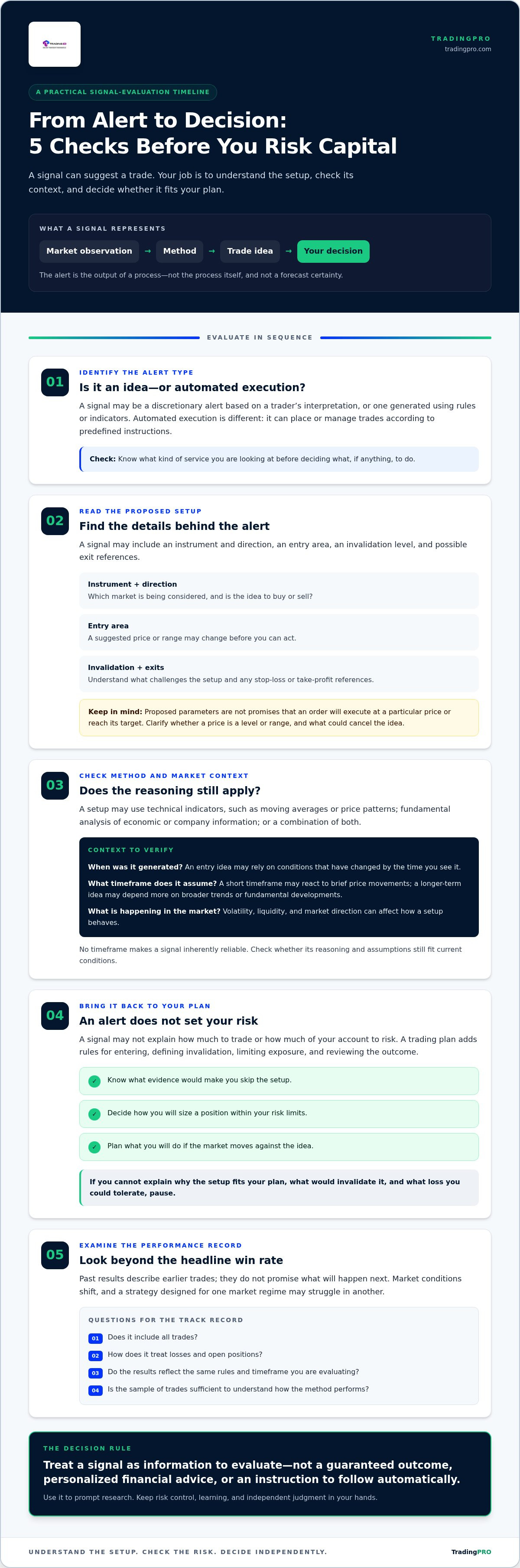
How to Evaluate a Trading Signal Before You Risk Capital
Use a repeatable review, not a polished screenshot or an impressive win-rate claim. Assess how the signal is built, what its complete record shows, and whether its risks fit your limits. Work through these steps before deciding whether to act.
- Understand the method. Identify the rules or analysis behind the alert, the market and timeframe it applies to, and the conditions that would invalidate it. If you can’t explain the setup in plain language, you don’t yet have enough context to judge it.
- Inspect the complete record. Look for dated results covering all trades in the stated period, including losses and open positions. Check that the record follows consistent rules rather than selecting only standout examples.
- Assess risk, not just wins. Review losing streaks, maximum drawdown, and the risk-reward profile. A high proportion of winning trades can still hide losses large enough to outweigh them. Consider whether reported results account for trading costs and realistic execution assumptions.
- Test before committing. Where suitable tools are available, observe the alerts or simulate decisions before putting meaningful capital at risk. Keep your own exposure limits and decide what would make you reject or exit a setup.
- Review what happened. Compare the stated rationale with the signal, your decision, and the outcome. Track skipped trades as well as trades taken, so you can judge the process rather than focus only on individual wins or losses.
Check transparency, consistency, and risk
Prefer clearly explained rules and dated records over selective screenshots or unsupported claims. Examine whether reported performance shows drawdowns and losing periods, and whether the dates, trade count, and methodology are clear enough to interpret. A credible signal record should show losses and methodology alongside winning trades. Treat claims of guaranteed returns or risk-free trading as serious warning signs, not evidence of reliability.
Context matters. A win rate has limited meaning on its own: the number of trades, how wins and losses are measured, and the size of each outcome all shape what the figure tells you. Don’t use one headline percentage to decide whether a signal suits your approach.
Test signals without surrendering control
Keep a journal with the date, signal rationale, relevant market conditions, and your reason for taking or passing on the idea. Note the planned risk before any trade and record the result using consistent rules. This helps reveal whether you’re following your plan or reacting to alerts. It also gives you a basis to reassess the method as conditions change.
If you’ve established your evaluation criteria and are ready to choose an account separately from any signal decision, create a TradingPRO account. Account access doesn’t validate a signal or remove trading risk.
Choose Your Next Step: Signals, Social Trading, or a Rookie Account
Make the decision in the right order. First, choose how involved you want to be in market decisions. Then assess any signal’s method, record, and risk before deciding whether it belongs in your plan. Choose an account after that. An account doesn’t verify a signal, validate someone else’s performance, or make a trading approach suitable for you.
If you use signals, understand how they’re generated, what could invalidate the idea, and how you’ll manage exposure. If you prefer to build your own view, independent analysis puts the research and decisions in your hands. Social or copy trading is a separate route: it involves following or replicating another participant’s activity, not simply receiving a trade alert. Each approach carries risk, and losses are possible.
Match your approach to your experience and involvement
Build your foundation first. Learn core market concepts and how position size, potential losses, and risk limits affect a trade before relying heavily on external ideas. Independent analysis demands more research but gives you direct practice. Signals can prompt your own assessment. Copy trading involves less discretion over individual trade choices, but still calls for attention to whom or what you follow and the exposure involved.
Choose based on the role you’re prepared to take, not on claims of effortless results. If you’re comparing your approach with available tools, explore the TradingPRO Trade Hub as part of your research. For account information, the Rookie Account overview provides a starting point. TradingPRO also offers Micro, Pro, and Scalp accounts, alongside social and copy trading. These are distinct account and trading options, not endorsements of any signal provider.
Make a measured move into live trading
Before committing capital, review the terms of the account you’re considering and decide whether its features fit your needs and risk tolerance. Keep account selection separate from signal evaluation. A suitable account won’t remove market risk, and following a signal or copying trades doesn’t prevent losses. If you’re still unsure, take more time to learn and test your decision process before trading live.
Once you’ve set your criteria, choose your next step deliberately. Decide whether you want to research independently, assess signals as one input, or explore social or copy trading. Then select an account that aligns with your needs. Register with TradingPRO to take the next step, guided by your own risk plan.
Build Your Next Move on a Clear Plan
Before acting on any market idea, decide what evidence you need, how much risk you’re prepared to take, and what would make you step back. That framework keeps your choices grounded in your own goals, whether you trade independently, consider signals, or explore another approach. The answer to “are trading signals worth it” depends on whether you can evaluate them without handing over your judgment.
TradingPRO offers Rookie, Micro, Pro, and Scalp account tiers, as well as social and copy trading. These are ways to access trading or follow other participants, not assurances of performance. Keep your account decision separate from your decision about signals, and choose only after reviewing the account terms and considering your risk tolerance.
Set your criteria, choose an approach you understand, and stay in control of each decision. Register with TradingPRO when you’re ready to take your next step.
Frequently Asked Questions
Are free trading signals worth using?
Free trading signals can help you learn how providers present trade ideas, but free access doesn’t establish quality. Treat alerts as material to study, not orders to copy. Notice whether the provider explains its approach or mainly uses free content to promote a paid service. Don’t share sensitive account credentials to receive an alert. Whether are trading signals worth it depends on what you can verify and how carefully you use them.
Can trading signals guarantee profits?
No. A signal can’t guarantee a profitable trade because prices may move unpredictably, and an order may not execute as expected. Even a well-researched idea can lose money. Be cautious of wording that promises certain returns or presents trading as risk-free. Before acting, decide what loss you could tolerate and avoid risking money you need for essential expenses.
How many trading signals should a beginner follow?
There’s no ideal number for every beginner. Start by observing a small, manageable set rather than collecting alerts from multiple sources. Too many competing ideas can make it difficult to tell which rules you’re following or why you entered a trade. Practise explaining each decision in your own words. If you can’t track the rationale and outcome consistently, reduce the number or pause.
Are trading signals legal?
Legality depends on where you live and what the provider actually does. Publishing general market commentary may be treated differently from giving tailored recommendations, managing accounts, or executing trades. Don’t assume a service is authorized simply because it operates online or shares testimonials. Check relevant official regulator resources for your jurisdiction, and review the provider’s identity, terms, and description of its service.
Can trading signals be automated?
Yes. Some systems send alerts for a person to review, while others can connect a signal to automated order execution. Before enabling execution, understand what permissions you’re granting, which markets and order sizes are involved, and how you can pause the system. Test the workflow in a simulated setting where possible, and don’t activate automation until you can explain what triggers an order.
Is a high win rate enough to judge a signal service?
No. A high win rate can still coincide with poor overall results if occasional losses are much larger than gains. Consider average gains and losses together, plus costs, before judging performance. For example, a strategy that wins frequently but takes a large loss on an occasional trade may have a negative overall expectancy. Check how the provider calculates its figures and what period they cover.
Should I pay for trading signals?
Pay only if you can explain what the service adds to your process and assess its evidence before committing. Treat the subscription as an expense separate from trading capital, and decide in advance what would make you cancel. Don’t borrow or increase your trading risk to afford a service. If its claims, methodology, or terms are unclear, wait and keep building your own market knowledge.


