




- Published on: 2026-07-30 05:49:36
Forex Risk Management 2026: Protect Your Capital

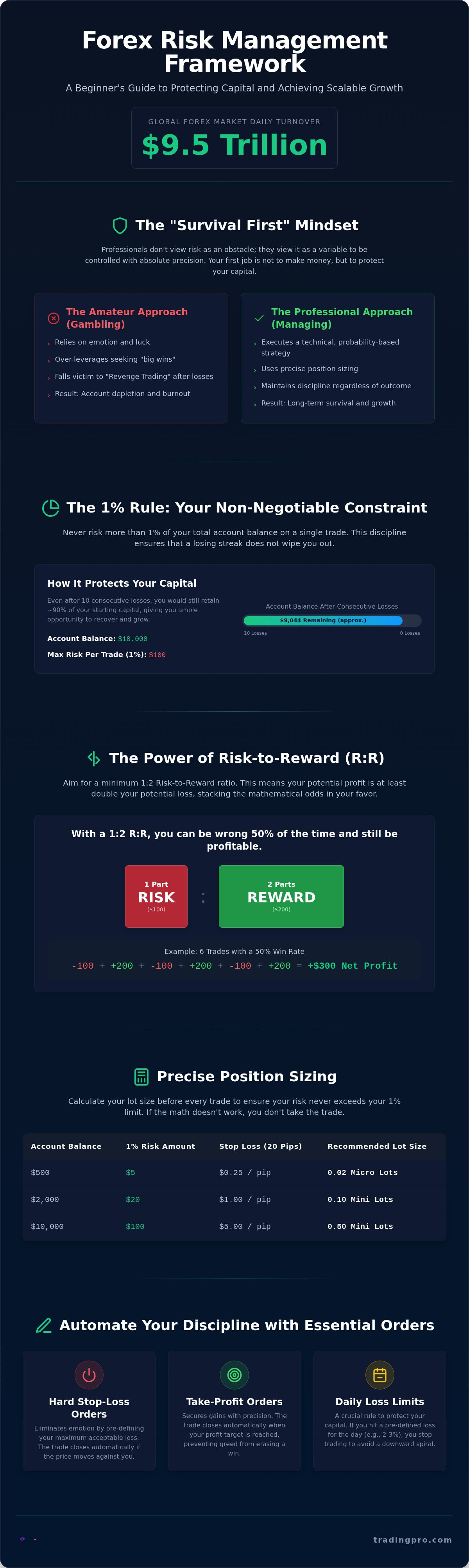
The global forex market now commands a staggering $9.5 trillion in daily turnover. It's a high-velocity arena where fortunes are built on precision and lost on hesitation. If you're just starting, the sheer scale of this volatility can feel overwhelming. Mastering forex risk management for beginners isn't just a safety net; it's your primary engine for growth. You need a strategy that transforms fear into calculated confidence.
We understand the pressure. You want the explosive growth that leverage offers but fear the margin calls that can vanish an account in seconds. It's time to stop guessing and start executing with the authority of a professional. This guide delivers the exact framework you need to survive the learning curve and scale your capital safely. We'll explore institutional-grade tactics, including the 1% rule and the security of negative balance protection, to ensure you remain a dominant force in the 2026 market. Get ready to trade with absolute clarity.
Key Takeaways
- Adopt a "Survival First" mindset to ensure you remain in the high-stakes forex arena long enough to achieve elite success.
- Implement forex risk management for beginners using the 1% rule, ensuring no single trade can compromise your account's longevity.
- Deploy hard stops and take-profit orders to eliminate emotional bias and secure gains with institutional-grade precision.
- Leverage Social Trading features by carefully evaluating drawdown metrics to mirror the success of professional strategies safely.
- Establish a definitive rookie roadmap with clear daily loss limits to maintain discipline and protect your capital during the learning curve.
What is Forex Risk Management and Why Does it Matter?
Effective forex risk management for beginners requires a fundamental shift from emotional guessing to technical authority. Amateurs treat the market like a casino. Professionals treat it like a high-performance business. By understanding foreign exchange risk, you develop an edge based on probability rather than luck. You aren't searching for a "sure thing" that doesn't exist. Instead, you're building a framework where the odds are in your favor and your downside is strictly capped. This institutional-grade protection is your foundation for global scaling.
The Reality of Market Volatility
Volatility is the frequency and magnitude of price changes. In the 2026 landscape, volatility is your greatest opportunity and your most significant threat. Global economic shifts now happen in milliseconds, fueled by high-frequency algorithms and instant data flows. Unprotected accounts can't withstand these sudden, violent movements. You need a platform that offers high-speed execution to ensure your stops trigger exactly where you intended. Precision is your best defense against market turbulence. Without it, you're just drifting in a storm.
Why Rookies Fail (And How to Avoid It)
Over-leveraging is the undisputed killer of new accounts. Beginners often see high leverage as a shortcut to wealth. In reality, it's a fast track to a zero balance. Don't fall for the trap of using maximum power before you've mastered the controls. Another common pitfall is "revenge trading." This is the emotional urge to "win back" money immediately after a loss. It's a destructive cycle that leads to reckless decision-making and total account depletion. Avoid these mistakes by starting with a Rookie Account. It acts as a controlled environment where you can refine your skills without risking catastrophic losses. It's the ultimate training ground for building a bulletproof risk plan.
The Mathematics of Survival: Position Sizing and the 1% Rule
Building on the foundation of survival, your mathematical approach must be absolute. Elite traders swear by the 1% Rule. This means you never risk more than 1% of your total account balance on a single trade. If your balance is $10,000, your maximum loss is $100. This discipline ensures that a losing streak doesn't wipe you out. Even a string of ten losses only depletes a fraction of your capital, leaving you with the resources to recover. Mastering forex risk management for beginners starts with this non-negotiable constraint. You aren't just trading; you're managing a portfolio with institutional-grade rigor.
Pair this discipline with a professional Risk-to-Reward Ratio. Aim for at least 1:2. This simple shift in perspective means your potential profit is double your potential loss. With a 1:2 ratio, you can be wrong 50% of the time and still grow your account. It's about playing the probabilities. For those starting with smaller capital, Micro Accounts provide the necessary granularity. They allow you to trade in micro lots, which are 1,000 units of currency, ensuring your position sizing remains precise even on a $100 balance. Amateurs gamble on "big wins" while professionals focus on consistent, scalable growth.
Calculating Your Risk-Per-Trade
To execute with precision, you must calculate your lot size before every entry. Use this formula: (Account Balance x Risk %) / Stop Loss in Pips. This calculation dictates whether you use a standard lot (100,000 units), a mini lot (10,000 units), or a micro lot (1,000 units). The difference determines your cost per pip and your total exposure. If the math doesn't work, you don't take the trade. Period.
| Account Balance | 1% Risk Amount | Stop Loss (20 Pips) | Recommended Lot Size |
|---|---|---|---|
| $500 | $5 | $0.25/pip | 0.02 Micro Lots |
| $2,000 | $20 | $1.00/pip | 0.10 Mini Lots |
| $10,000 | $100 | $5.00/pip | 0.50 Mini Lots |
The Double-Edged Sword of Leverage
Leverage is a high-performance tool designed to amplify your market reach. It allows you to control large positions with a small margin deposit. While US regulators like the CFTC cap retail leverage at 50:1 for major pairs in 2026, "maxing out" this power without a protective plan is a recipe for disaster. High leverage accelerates both gains and losses. Focus on mitigating foreign exchange risk by aligning your leverage with your actual risk tolerance. Use leverage to enhance your strategy, not to inflate your ego. Ready to apply these calculations? Open your account today and start trading with professional-grade precision.
Precision Defense: Using Stops, Limits, and Execution Speed
Precision is the hallmark of an elite trader. While mathematics defines your risk, technology enforces it. In a market moving $9.5 trillion daily, you cannot rely on manual reactions. A "mental stop" is nothing more than a hope, and hope is not a strategy. It dissolves the moment market pressure hits. You must use hard stops. These are automated sentries that close your position the instant your risk threshold is reached. This removes emotional hesitation from the equation entirely. Mastering forex risk management for beginners means moving beyond manual intervention and embracing automated discipline.
Equally vital are "Take Profit" orders. Markets in 2026 are characterized by violent reversals. If you don't lock in gains at predetermined levels, the market will take them back. Secure your wins with the same rigor you use to cap your losses. TradingPRO provides a definitive "safe-haven" through Negative Balance Protection. This institutional-grade guarantee ensures you can't lose more than you deposit, even during extreme black-swan events. This safety net is essential for maintaining your capital base. To further minimize risk, utilize high-speed execution to prevent slippage. In high-volatility environments, execution speed is the silent partner of forex risk management for beginners, ensuring your orders fill at the price you see, not the price the market dictates seconds later.
Mastering the Stop-Loss
Strategic placement is everything. Don't place stops at random intervals. Instead, anchor them just beyond technical support and resistance levels. This gives your trade room to breathe while ensuring an exit if the setup fails. For trending markets, deploy "Trailing Stops." These dynamic orders move with the price, locking in profits as the trade progresses in your favor. A Stop-Loss Order is an automated instruction to close a trade at a specific price. Use it to maintain absolute control over your downside at all times.
Infrastructure as Risk Mitigation
Your trading infrastructure is a core component of your defense. Low-latency platforms are non-negotiable because they reduce the risk of "price gaps" during news events. Use the Trade Hub as your tactical command center. It allows for real-time monitoring of your total market exposure across all pairs. In high-stakes environments, even a minor connectivity lag can be costly. Ensure your setup is stable, professional, and built for speed. Reliability isn't just a luxury; it's a fundamental requirement for protecting your capital in the fast-paced 2026 landscape.
Social Trading Guardrails: Managing Risk When Copying Pros
Social trading is a high-performance accelerator, but it isn't a "set and forget" solution. Replicating the trades of an elite professional doesn't eliminate your personal responsibility. You remain the ultimate manager of your capital. Effective forex risk management for beginners in a social context requires you to audit the experts you follow with institutional rigor. Don't be blinded by flashy return percentages. Instead, focus on "Drawdown." This critical metric represents the historical peak-to-trough decline in a trader's account. A master with 100% returns but a 50% drawdown is a high-stakes gamble, not a stable investment. Deploy "Copy Stop-Loss" limits to automatically sever the connection if a master’s strategy drifts into unacceptable territory. This ensures a single failing strategy cannot compromise your entire portfolio.
Think of Social Trading as a partnership where you provide the capital and the Master provides the execution. However, your platform must provide the safety net. By integrating these guardrails, you transform passive copying into an active, controlled growth strategy. You aren't just following; you're leading your own success by setting the parameters of your exposure. This proactive stance is what separates the long-term winners from those who disappear during the first market correction. Control the variables you can, and automate the rest to maintain your edge.
Evaluating Master Trader Metrics
Returns are only half the story. You must analyze the "Risk Score" and consistency over time. High win rates are often a psychological trap. They can indicate a trader who "holds and hopes," refusing to close losing positions until they become catastrophic. Look for a sustainable balance between average gains and average losses. Consistency in execution is the hallmark of a true professional. For a deep dive into these selection criteria, consult our guide on how to choose a trader to copy. It delivers the technical framework needed to filter out the noise and find genuine market leaders.
Allocating Capital Wisely
Never allocate 100% of your balance to a single copied strategy. Diversification is your primary defense against individual trader error. Spread your capital across multiple masters with contrasting styles, such as pairing a high-frequency scalper with a conservative swing trader. This smooths out your equity curve and reduces the impact of any single strategy's underperformance. Use "Proportional Copying" to ensure your risk exposure mirrors the Master's intent without exceeding your predetermined lot limits. Regular portfolio rebalancing is mandatory. If a trader's style no longer aligns with the 2026 market dynamics, rotate your capital to a more relevant strategy immediately. This agility is the essence of forex risk management for beginners. Ready to leverage elite strategies with professional-grade safety? Join our Social Trading community now and start building your diversified portfolio.
Your Rookie Roadmap: Building a Bulletproof Risk Plan
Your journey toward elite performance culminates in a definitive action plan. Mastering forex risk management for beginners requires more than theory; it demands a structured sequence of execution. You need a roadmap that transitions you from a novice to a disciplined market participant. This isn't about guessing. It's about building a high-performance infrastructure where every loss is calculated and every win is earned through precision.
- Step 1: Define your limits. Set a hard ceiling for daily and weekly losses. If you hit these numbers, stop trading immediately. This takes the pressure off your shoulders and prevents emotional exhaustion. Absolute discipline is your only protection against a downward spiral.
- Step 2: Establish your criteria. Create a checklist for your "Trade Setup." If the market doesn't meet every single parameter of your plan, you don't enter. Patience is a competitive advantage in a high-velocity environment.
- Step 3: Document everything. Record every entry, exit, and the rationale behind them. This journal is your most valuable asset for identifying behavioral risks before they become expensive.
- Step 4: Stress-test your strategy. Utilize a Demo Account to refine your risk parameters. Practice until your execution is flawless and your emotions are detached from the outcome.
- Step 5: Execute with skin in the game. Transition to a Rookie Account to practice discipline with real capital. This is the ultimate training ground where theory meets the reality of the 2026 market.
The Power of the Trading Journal
Data is the lifeblood of a professional trader. Your journal must track more than just pips. Document "Why I entered" and "How I felt" during the trade. This qualitative data is essential for spotting 'Tilt', those emotional trading patterns that lead to ruin. Review your journal every weekend. Analyze your patterns with brutal honesty. If you see a recurring emotional mistake, such as entering too early due to fear of missing out, adjust your plan to neutralize it. Turning your weaknesses into data points is how you build a superior risk edge.
Continuous Education and Adaptation
The 2026 market is dynamic. What works today may require adjustment tomorrow. Stay ahead of the curve by following the TradingPRO Blog for the latest insights on shifting market themes and central bank policies. As your capital grows and your confidence solidifies, your risk plan must evolve. Scaling from a Rookie Account to a Pro Account requires a recalibration of your lot sizes and exposure limits. You've already mastered the basics. Now, focus on the precision that global leaders demand. Forex risk management for beginners is the foundation, but continuous adaptation is the key to longevity. Commit to the process, trust your math, and execute with absolute authority.
Master Your Market Destiny
Success in the 2026 forex market belongs to the disciplined. By mastering the 1% rule and deploying automated precision through hard stops, you've already moved beyond the amateur crowd. You don't need luck when you possess a bulletproof roadmap and institutional-grade defense. This comprehensive foundation in forex risk management for beginners acts as your primary engine for sustainable growth. It's time to stop reacting to volatility and start capitalizing on it with absolute authority.
Your evolution into an elite trader requires a partner that values speed and security. TradingPRO delivers the professional infrastructure you need to excel. Benefit from Negative Balance Protection that keeps your capital safe and institutional-grade execution speed that ensures your strategy hits the mark every time. Plug into elite Social Trading networks to leverage expert insights while you scale your own performance. Launch Your Trading Journey with a TradingPRO Rookie Account now. The landscape is shifting rapidly. Seize the momentum and trade with the confidence of a global leader.
Frequently Asked Questions
What is the 1% rule in forex trading?
The 1% rule is a foundational principle where you never risk more than 1% of your total account balance on a single trade. This strategy ensures that even a string of losses won't deplete your capital. It's a non-negotiable standard for professional-grade forex risk management for beginners. By capping your downside, you maintain the resources needed to capitalize on future market opportunities.
Can I lose more than my initial deposit with TradingPRO?
No, you cannot lose more than your initial deposit. TradingPRO provides Negative Balance Protection as a standard security feature for retail clients. This institutional-grade safeguard ensures that your account balance never drops into the negative, even during extreme market volatility. It creates a safe-haven environment, allowing you to trade with absolute confidence and security.
What is the best risk-to-reward ratio for beginners?
Aim for a minimum risk-to-reward ratio of 1:2. This means your potential profit is twice the size of your potential loss. This mathematical advantage allows you to remain profitable even if you only win 40% of your trades. Professionals focus on these probabilities to ensure consistent account growth. Avoid ratios lower than 1:1, as they require an unsustainably high win rate to survive.
How do I calculate the correct lot size for my trade?
Calculate your lot size using the formula: (Account Balance x Risk Percentage) divided by Stop Loss in Pips. This precise calculation dictates whether you should use a standard, mini, or micro lot. Never guess your position size. Use this formula before every entry to ensure your exposure aligns perfectly with your risk plan. It's the only way to maintain total control over your capital.
What is drawdown and why should I care about it?
Drawdown is the percentage decline from a peak in your account balance to its lowest point before a new peak is achieved. It's a critical metric for evaluating the true risk of a trading strategy. High drawdown indicates high volatility and potential instability. You must monitor this closely to ensure your strategy remains within your emotional and financial tolerance limits.
Is leverage dangerous for new traders?
Leverage is a high-performance tool that amplifies both gains and losses. It isn't inherently dangerous, but it becomes a liability when used without a definitive risk plan. Beginners often over-leverage, which leads to rapid account depletion. Use leverage to enhance your strategy's reach, not to inflate your position size beyond what your risk-per-trade rules allow. Precision is key.
What happens if my account balance falls below the margin requirement?
If your balance falls below the required margin, the platform triggers a margin call or an automatic stop-out. This is a protective mechanism that closes your open positions to prevent further losses. Maintain a healthy margin level to ensure your trades have room to breathe during sudden price fluctuations. Monitoring your margin utilization is a vital part of forex risk management for beginners.
How does high-speed execution affect my risk management?
High-speed execution minimizes slippage, which is the difference between your requested price and the actual fill price. In fast-moving markets, even a few milliseconds of delay can result in a worse entry or exit. Rapid execution ensures your stop-loss orders trigger exactly where you intended. It's a vital component of technical defense, providing the edge needed to protect your capital in 2026.


