




- Published on: 2026-08-27 10:15:59
How Brokers Make Money: The 2026 Insider Guide to Trading Revenue Models
"Zero commission" isn't a gift. It's a calculated business strategy that often masks the real price you pay for market access. You've likely felt the frustration of a trade that appeared free on paper, only to see your profits eroded by massive spreads or execution delays. Understanding how brokers make money is the only way to move from being a source of revenue to a dominant force in the markets. It's time to stop guessing and start trading with institutional-grade clarity.
You deserve full transparency on every tick. We agree that hidden fees and opaque execution models are the enemies of your success. This guide demystifies the mechanics of brokerage revenue in 2026, empowering you to choose a partner that prioritizes your growth. We'll examine the critical shift following the EU's total ban on payment for order flow and dissect the difference between A-book and B-book models. From the high-performance Scalp account environment to the accessible Rookie entry point, you'll learn how to optimize your costs for peak performance. Prepare to master the math behind the markets and secure your status as an elite trader.
Key Takeaways
- Master the core mechanics of how brokers make money through spreads, commissions, and swaps to safeguard your trading capital against hidden costs.
- Navigate the critical differences between A-Book and B-Book execution models to ensure your strategy aligns with institutional-grade risk management.
- Optimize your profitability by selecting specialized environments, such as the Scalp Account for high-frequency precision or the Rookie Account for a low-barrier entry.
- Leverage the latest 2026 regulatory shifts, including the global crackdown on payment for order flow, to demand elite transparency and superior execution quality.
- Transform your trading ROI by matching your specific style with the right revenue model, ensuring every pip contributes to your bottom line.
The Mechanics of Brokerage: Decoding the Revenue Mystery
A broker serves as the essential bridge between your terminal and global liquidity pools. Without this connection, retail participants couldn't access the trillions of dollars flowing through global markets. Per the standard Broker-dealer definition, these entities act as agents for clients while also trading for their own accounts. This dual role is where the complexity begins. Many traders mistakenly believe that "zero commission" means zero cost. In reality, "free" trading is a marketing hook. Understanding how brokers make money requires looking past the surface and into the plumbing of the financial system.
Brokers incur massive institutional infrastructure costs to keep your trades running. They pay for high-speed data feeds, secure servers, and liquidity aggregation from top-tier banks. To cover these expenses and generate profit, the industry has shifted away from traditional flat commissions. Most modern platforms now rely on spread-based models. This transition allows for smaller entry sizes; however, it requires traders to be more aware of the bid-ask gap. Managing these overheads while maintaining lightning-fast execution is a balancing act that separates elite providers from the rest.
Why Transparency is Your Greatest Trading Edge
Knowledge is power in a high-stakes environment. When you don't understand the fee structure, you're trading in the dark. This uncertainty often leads to emotional decision-making or panic during minor drawdowns. Hidden costs like wide spreads or slippage can quietly erode your long-term profitability. At TradingPRO, we provide institutional-grade clarity across all tiers. Whether you're starting with a Rookie Account or an advanced setup, knowing your exact costs allows you to calculate true ROI with precision. Transparency eliminates the guesswork and lets you focus on execution.
The Evolution of the Brokerage Business Model
The landscape has transformed from chaotic physical trading floors to silent, high-speed digital execution. This evolution democratized the markets. In the past, only elite institutions could participate. Now, micro-lot accessibility means anyone can start with minimal capital. By 2026, technology has effectively lowered entry barriers to near zero. High-frequency algorithms and AI-driven liquidity management now ensure that retail orders are filled with speeds that were once reserved for hedge funds. This shift forces brokers to be more efficient. They now compete on execution quality rather than just access. You are the beneficiary of this technological arms race. Understanding how brokers make money in this digital era is the first step toward professional-grade risk management.
Primary Revenue Streams: Spreads, Commissions, and Swaps
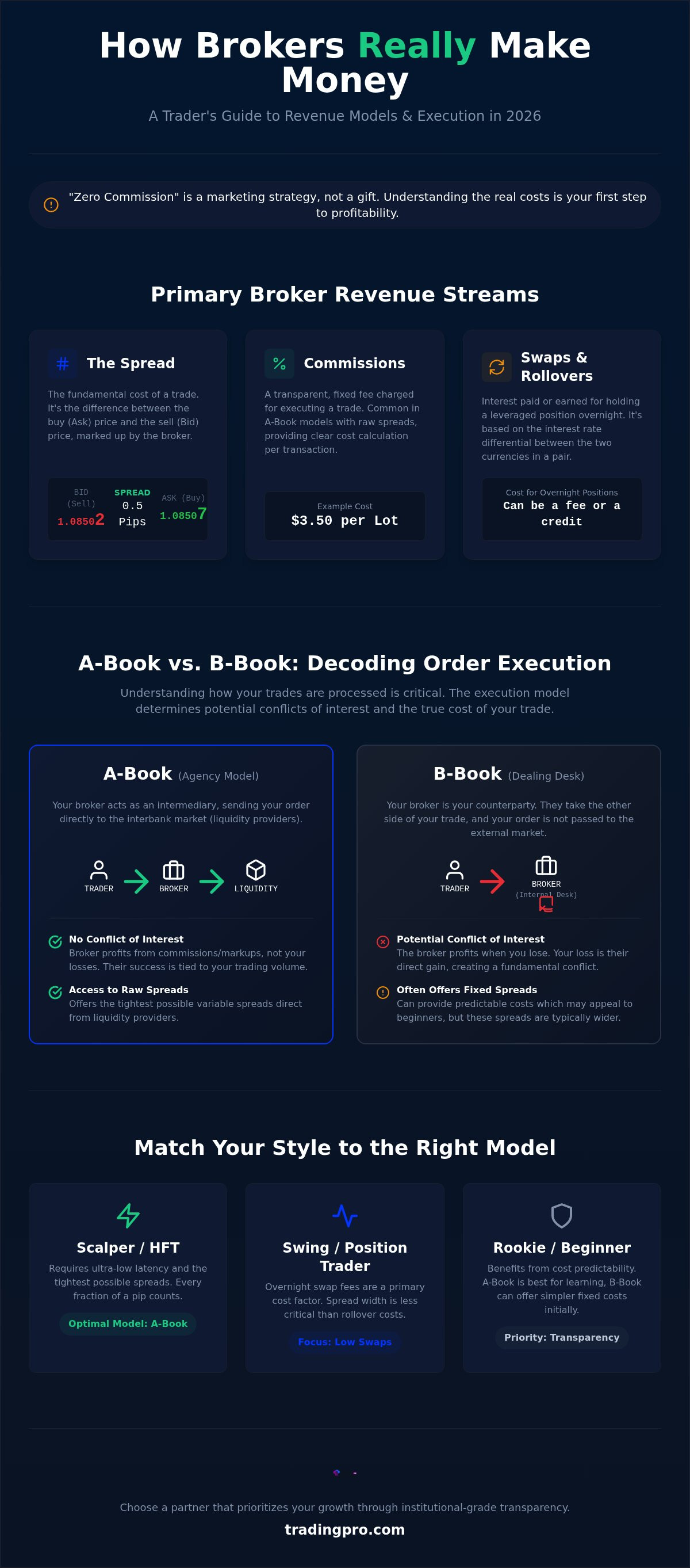
The mechanics of a trade ticket reveal exactly how brokers make money on every click. It's not a mystery; it's a structured fee system designed to facilitate your access to global liquidity. Most traders focus solely on the entry price, but the real cost of business is found in the delta between the bid and the ask. This revenue isn't just profit. It's the engine that powers the high-speed infrastructure required to execute your orders in milliseconds.
The Spread: Your Cost of Market Entry
The spread is the most direct revenue engine. It's the difference between the price you buy at and the price you sell at. In liquid markets, spreads are razor-thin. When volatility spikes, they widen. Liquidity providers, the massive banks and institutions behind the curtain, dictate the raw price. A broker adds a small markup to this raw spread to cover operational overhead. Fixed spreads offer predictability during news events, while variable spreads often provide the tightest pricing during standard market hours. Understanding this gap is vital for calculating your break-even point on every position.
Swaps and Roll-Overs: Financing Your Leverage
Holding a position past the daily close triggers a swap. Swaps represent another layer of how brokers make money while providing you with institutional leverage. This is essentially interest paid or earned for the privilege of using leverage overnight. Because you're trading currency pairs, you're dealing with interest rate differentials. If you buy a currency with a higher interest rate than the one you sell, you might earn a credit. Conversely, you'll pay a fee if the differential is negative. Swing traders must factor these daily roll-overs into their ROI calculations to avoid unexpected drawdowns.
Commission Models: Transparency in Every Lot
Professional traders often bypass spread markups entirely. They opt for ECN-style accounts that offer raw market spreads paired with a flat commission. This model provides maximum transparency. You see the true market price and pay a fixed fee per lot traded. It's often the most cost-efficient path for high-volume participants who need to know their exact overhead before entering a trade. You can explore our ScalpX infrastructure for zero-spread options to see how this model accelerates execution speed and simplifies your cost analysis.
Beyond these primary streams, some platforms rely on administrative charges. Inactivity fees or withdrawal costs are common across the industry. These "hidden" revenue sources often penalize passive participants. To avoid these traps, choose a partner that values active performance over administrative penalties. Your focus should remain on the charts, not on decoding a complex fee schedule. Secure your trading future today and experience a revenue model built for your success.
A-Book vs. B-Book: Decoding Order Execution Models
Execution logic is the engine room of your trading experience. To master how brokers make money, you must look beyond the spread and into the order book. Your broker's execution model dictates whether your order hits the global market or stays within an internal ecosystem. Understanding this distinction isn't just academic. It's about knowing where your liquidity comes from and who sits on the other side of your trade. Modern infrastructure has moved past the simple "broker vs. trader" narrative, replacing it with sophisticated risk management.
A-Book models, including STP and ECN, act as a transparent conduit. They pass your orders directly to external liquidity providers. In this setup, the broker wins when you trade more; your longevity is their profit. Conversely, B-Book models involve the broker acting as the market maker. While critics often highlight a potential conflict of interest, the reality is more nuanced. B-booking allows for instantaneous execution and deep liquidity, even when the broader market is thin. It provides a necessary buffer for retail participants who need guaranteed fills.
STP and ECN: Direct Market Access (DMA)
Straight-Through Processing (STP) eliminates manual intervention. It's pure speed. By 2026, Electronic Communication Networks (ECN) have become the gold standard for high-volume traders who prioritize Direct Market Access. This infrastructure connects you to a global pool of banks and hedge funds, ensuring you get the best possible price from multiple sources. DMA is the weapon of choice for professionals who demand zero interference and absolute transparency in their execution chain.
Market Making: Ensuring Liquidity in All Conditions
Market makers provide the vital service of liquidity. Without them, your orders might languish during low-volume sessions or after-hours gaps. In a B-book environment, the broker manages the risk of your trade internally. This model is essential for retail accessibility, offering a frictionless entry point. To protect you, elite brokers implement Negative Balance Protection, ensuring you never lose more than your initial deposit. It's a safe-haven approach for those building their confidence. You can start your journey with a TradingPRO Rookie Account to experience this reliable execution firsthand.
The most sophisticated brokers in 2026 utilize a hybrid model. They route high-volume, professional flow to the A-book while managing smaller retail flow through the B-book. This balance optimizes how brokers make money while providing you with the best of both worlds: institutional speed and retail reliability. The myth that brokers want you to fail is a relic of the past. Successful traders generate more volume, more commissions, and more longevity for the platform. Your success is the primary driver of our growth engine.
How Your Trading Style Influences Broker Revenue
Your strategy is the blueprint for your cost structure. One size never fits all in global markets. A high-frequency scalper and a long-term swing trader interact with liquidity in fundamentally different ways. This interaction determines how brokers make money from your specific activity. By aligning your style with the correct revenue model, you transform overhead into a competitive advantage. It's about precision. It's about knowing which environment fuels your specific edge.
Scalpers are high-volume engines. They rely on razor-thin margins and lightning-fast execution. For these traders, revenue is generated through the sheer frequency of trades on tight spreads. If you are clicking "buy" and "sell" dozens of times a day, even a fractional pip difference determines your survival. Day traders operate with a different rhythm. They balance execution speed with daily cost management. While they avoid the overnight swaps that swing traders pay, they require robust intraday stability to navigate peak volatility sessions.
Choosing the Right Account Tier for Your Strategy
Our infrastructure is built to mirror your ambition. The Rookie Account provides a low-barrier entry point for those mastering the basics without complex overhead. It's the ideal starting line. For high-frequency pros, the Scalp Account utilizes our ScalpX high-performance environment. This tier delivers institutional speed and raw spreads for those whose strategies demand zero lag. TradingPRO’s multi-tier system ensures you only pay for the infrastructure you actually use. This optimization is the key to higher ROI.
Social Trading: A Win-Win Revenue Ecosystem
Social trading shifts the traditional dynamic into a collaborative powerhouse. It's a win-win ecosystem where strategy providers earn performance fees for their proven expertise. The broker facilitates this by maintaining the social feed and ensuring frictionless mirror execution. This setup creates mutual value. The broker earns through increased volume, while providers and followers share in the rewards of professional-grade execution. You can dive deeper into these mechanics by reading our Social Trading vs Copy Trading guide. This model proves that how brokers make money can be directly tied to the collective success of the community.
Stop settling for generic execution that erodes your profits. Your strategy deserves an environment designed for its specific demands. Register your account now and choose the tier that powers your path to dominance.
TradingPRO’s Transparent Infrastructure: Built for Your Success
Knowing how brokers make money is your first step toward professional autonomy. Now, you need an environment that respects your capital and your ambition. TradingPRO delivers a tiered infrastructure designed for peak performance. We don't hide behind complex fee schedules or opaque execution. Instead, we empower your journey through specialized environments that match your specific style. Whether you're scaling up with a Scalp Account or starting fresh with a Rookie Account, our system prioritizes your execution speed above all else. Transparency isn't a buzzword here; it's the foundation of our institutional-grade service.
The TradingPRO Advantage: Speed, Precision, Empowerment
Dynamic execution is the heartbeat of our multi-asset platform. We've eliminated the friction that often plagues retail trading. There are no hidden fees or "gotcha" costs here. You get institutional-grade speed that ensures your orders fill at the price you see, even in fast-moving markets. We believe that a successful trader is a long-term partner. By removing the barriers of high-latency execution and wide spreads, we create a direct path for your consistent growth. It's time to join our global community and register today to experience the difference that elite infrastructure makes.
Tools for Performance: Beyond the Account
Precision requires more than just a fast connection. You need elite insights and a capital boost to maximize your market presence. Our Trade Hub provides advanced market data and technical insights that clarify how brokers make money and how you can save on every lot you trade. Additionally, we offer a powerful way to expand your margin and seize more opportunities. You can claim your TradingPRO Deposit Bonus to boost your trading potential and secure more market exposure. These aren't just perks. They are strategic tools designed to give you a decisive institutional edge over the competition.
Stability is the foundation of our global reach. We protect our traders with comprehensive risk management and mandatory negative balance protection. You'll never owe more than you deposit. This safety net provides the confidence needed to pursue significant goals in high-stakes markets. Our global partner network focuses on continuous education, ensuring you stay ahead of 2026's fast-moving trends. We are more than a platform. We are your seasoned authority and partner in market dominance. Success is within your reach; we provide the tools to grab it.
Secure Your Edge in the Modern Marketplace
Transparency is the ultimate weapon in a high-stakes environment. You now understand the mechanics behind how brokers make money, from the nuances of A-book execution to the precision of spread markups. This knowledge transforms you from a passive participant into an empowered strategist. By selecting an infrastructure that aligns with your specific volume and style, you eliminate the friction that stalls most retail journeys. Navigating the 2026 landscape requires more than just a strategy; it requires a partner that prioritizes your execution speed and capital security.
It's time to leverage this clarity and join a global multi-asset infrastructure built for your dominance. With 4 specialized account tiers and guaranteed negative balance protection, you have the institutional-grade safety and speed required to excel in any market condition. Start Trading with Institutional Precision at TradingPRO. The markets move fast. Don't let opaque fees or wide spreads hold you back. Step into the elite circle and claim your success today. Your journey to market mastery starts with a single, decisive click.
Frequently Asked Questions
Do brokers make money when I lose a trade?
Only in a pure B-Book or Market Maker model does the broker profit directly from your losses. In this scenario, the broker acts as your counterparty. However, most elite providers utilize a hybrid or A-Book model where they earn through spreads and commissions regardless of your trade outcome. They actually prefer you to be successful; profitable traders trade more often and generate higher volume over time.
What is the difference between a spread and a commission?
A spread is the delta between the buy and sell price, acting as a built-in markup on every trade. A commission is a transparent, flat fee charged per lot. High-performance environments like the Scalp Account often feature raw spreads from liquidity providers combined with a fixed commission. This model provides the institutional-grade clarity that professional traders need to calculate their precise overhead before entering a position.
How can a broker offer "zero commission" trading?
Brokers offering "free" trading typically monetize through wider spreads or other backend revenue streams. While you don't see a separate line item for a fee, the cost is embedded in the price you pay to enter and exit. Understanding how brokers make money through these markups is vital. It allows you to compare the total cost of ownership between a zero-commission account and a raw-spread ECN account.
What are overnight swap fees and how are they calculated?
Swap fees are interest rate differentials applied when you hold a position past the market close. These are calculated based on the interest rate gap between the two currencies in a pair. Depending on the direction of your trade and the current central bank policies, you'll either pay a financing fee or earn a credit. Swing traders must factor these daily roll-overs into their long-term ROI projections.
Is it better to use an ECN or a Market Maker broker?
Your choice depends on your specific trading style. ECN brokers offer direct market access and raw spreads, which are essential for high-frequency pros. Market Makers provide deep liquidity and instant execution, making them an excellent safe-haven for beginners using a Rookie Account. The most sophisticated brokers in 2026 use a hybrid model to deliver the speed of an ECN with the reliability of a market maker.
Can a broker manipulate prices to trigger my stop loss?
Regulated brokers use institutional-grade data feeds that are nearly impossible to manipulate without detection. While spreads naturally widen during extreme volatility or low liquidity, this is a market reality rather than broker interference. Using a partner with a global multi-asset infrastructure ensures you receive fair, transparent pricing. Protecting your stops requires understanding market depth rather than fearing broker manipulation in a secure, regulated environment.
How do social trading platforms make money?
Social trading ecosystems generate revenue through a combination of increased trade volume and performance fee sharing. The platform earns from the spreads on every mirrored trade while facilitating a win-win environment for providers and followers. This model aligns the broker’s profit with the success of the community. It proves that how brokers make money can be a transparent, collaborative process that rewards expert strategy and consistent execution.
Why do some brokers charge inactivity fees?
Inactivity fees help offset the high cost of maintaining secure, high-speed server infrastructure for dormant accounts. Brokers invest heavily in data security and real-time feed maintenance. If an account isn't generating trade-based revenue, these administrative charges cover the overhead of keeping your account active and ready for use. Active traders who utilize their accounts regularly will almost never encounter these specific administrative penalties.


