




- Published on: 2026-10-13 12:11:45
How to Copy Trade Professional Traders: A Practical Guide

Copying a professional trader can mirror their market positions, but it can’t transfer their judgment or guarantee a result. If you’re wondering how to copy trade professional traders without handing over control, first understand what happens: a selected trader’s activity is replicated in your account, where results can differ and losses are possible.
Performance history can help you assess a strategy, but copying trades is observation, not direct mentorship. You won’t automatically learn why a trader made each decision, and past success doesn’t ensure future returns.
This guide explains how copy trading works, what to review before enabling it, and how to set personal limits and monitor activity. It also compares automated copying with studying market activity and learning through mentorship. TradingPRO offers social and copy trading alongside Rookie, Micro, Pro, and Scalp accounts. Choosing an account tier and choosing a strategy are separate decisions.
Key Takeaways
- Copy trading replicates a selected trader’s market actions in your account, exposing it to potential losses as well as market opportunities.
- Use a deliberate workflow: prepare, review account information and platform terms, assess a trader, then monitor copied activity.
- Automated copying, manual study, and mentorship differ in control, feedback, and time commitment.
- A professional trader can still lose. Treat past performance as historical information, not a promise of future results, and keep your own risk decisions in view.
- TradingPRO offers social and copy trading alongside Rookie, Micro, Pro, and Scalp accounts. Consider your account choice separately from the strategy you follow.
How to Copy Trade Professional Traders: Understand What You Are Following
Copy trading links your account activity to a selected trader’s activity. When that trader makes a market move, the copy-trading arrangement may replicate a corresponding action in your account. The precise process depends on the platform’s terms, so understand how the arrangement works before committing funds.
Copy trading mirrors a selected trader’s market activity. It does not transfer their expertise or promise a particular performance. A copied position is exposed to market movements and can lose value. Automation follows activity; it doesn’t remove risk or turn a trade into a likely profit.
What does copying a professional trader actually do?
When a trader you follow opens or changes a position, the arrangement may replicate corresponding activity in your account. You remain exposed to the outcome there. A “professional” label doesn’t change that, and the trader’s experience doesn’t transfer with the copied activity.
For example, if a selected trader opens a position, copying may cause a related position to appear in your account. You can observe the action, but you may not see the reasoning behind it: what the trader was watching, what risks they considered, or what would make them change course. The activity is visible; the judgment behind it may not be.
This is central to how to copy trade professional traders: automation can mirror decisions, but it can’t assess whether those decisions suit your goals, circumstances, or tolerance for loss. For a foundational overview of the terminology and background, see What is copy trading?
Copy trading versus mentorship: what is the difference?
Copying is primarily a way to follow market activity. Mentorship is a learning relationship built around explanation, questions, and feedback. A mentor may discuss why a decision was made and help you examine your own reasoning. Copying alone doesn’t provide that personal instruction.
Observation can still prompt learning. When you notice a trader entering or exiting a position, write down questions: What market conditions might have influenced the move? What could change the outlook? Investigate those questions independently. Treat the activity as a subject for study, not proof that the decision was right for you.
- Copy trading: mirrors selected trading activity, while you remain responsible for understanding the exposure.
- Mentorship: offers direct discussion and feedback, but is distinct from an automated copying arrangement.
Social trading and copy trading are related terms, but they don’t always describe the same interaction. Watching or discussing market activity is not the same as automatically replicating it, and neither should be mistaken for personalized teaching.
How to Start Copy Trading: A Clear Setup and Review Workflow
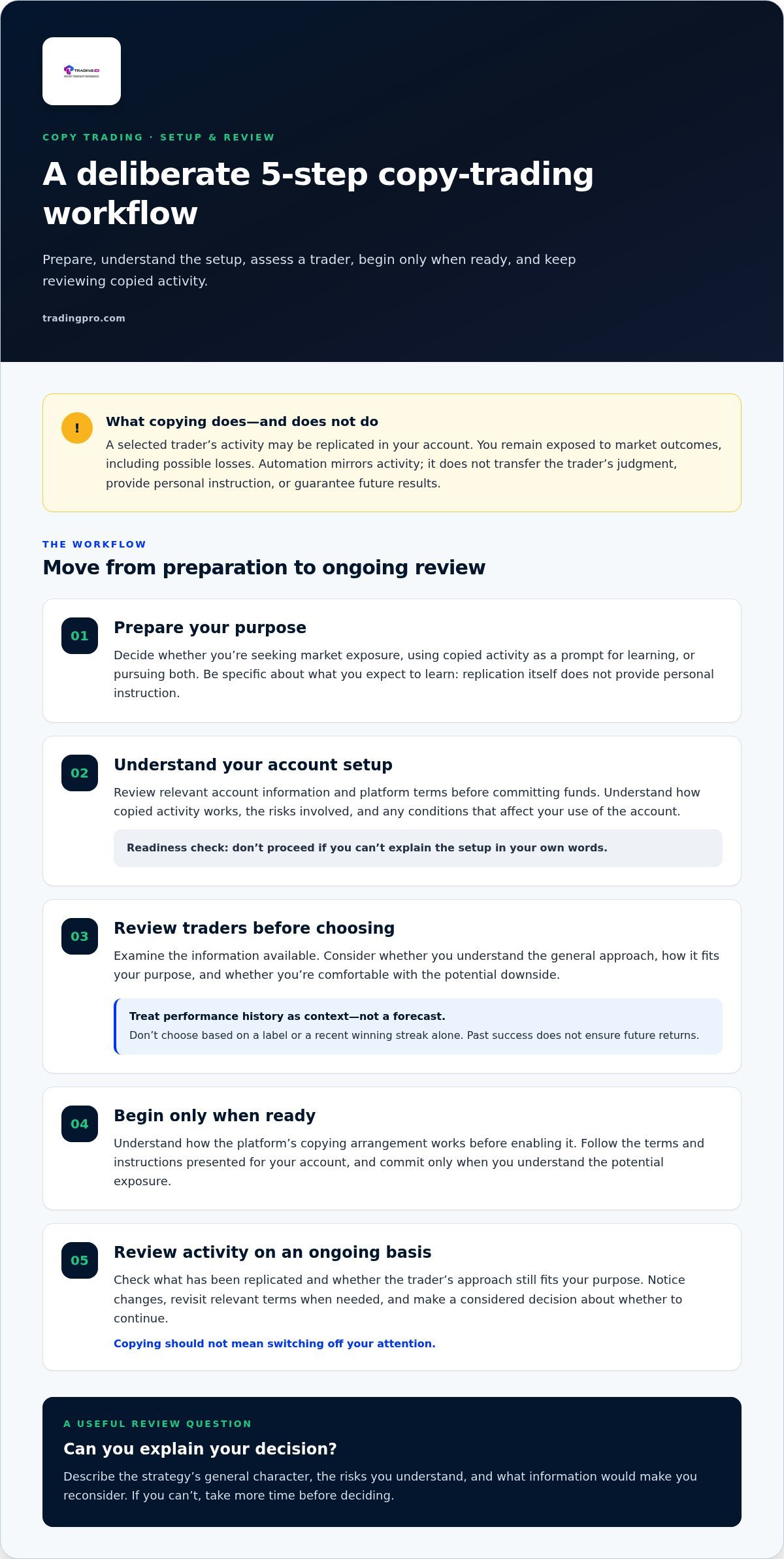
A deliberate setup begins before you follow anyone. Decide what you want from the experience, understand the account and platform terms, and make sure you can explain how copied activity may affect your funds. Then work through five steps: prepare, understand the setup, assess a trader, begin only when ready, and review activity.
If trading language feels unfamiliar, start with the basics. Terms such as position size, leverage, volatility, and drawdown can shape how you interpret a trader’s activity and risk. Build your foundation with a forex trading beginners guide before enabling automated replication. Copy trading is still an investment activity with risks, as explained in the SEC’s overview of copy trading and its risks.
- Prepare your purpose. Decide whether you’re seeking market exposure, using copied activity as a prompt for learning, or pursuing both. Be specific about what you expect to learn. Replication itself doesn’t provide personal instruction.
- Understand your account setup. Review the relevant account information and platform terms before committing funds. Look at how the arrangement describes copied activity, the risks involved, and any conditions that affect your use of the account. Don’t proceed if you can’t explain the setup in your own words.
- Review traders before choosing. Examine the information available about each trader. Consider whether you understand the general approach, how it fits your purpose, and whether you’re comfortable with the potential downside. Treat performance history as context, not a forecast. Don’t choose based on a label or a recent winning streak alone.
- Begin only when ready. Understand how the platform’s copying arrangement works before enabling it. Follow the terms and instructions presented for your account, and commit only when you understand the potential exposure.
- Review activity on an ongoing basis. Check what has been replicated and whether the trader’s approach still fits your purpose. Notice changes, revisit relevant terms when needed, and make a considered decision about whether to continue. Copying shouldn’t mean switching off your attention.
Trader selection can be tempting to reduce to a leaderboard or recent results. Instead, use a simple review: can you describe the strategy’s general character, the risks you understand, and what information would make you reconsider? If not, take more time before deciding.
This workflow helps you approach how to copy trade professional traders without confusing automated replication with automatic judgment. TradingPRO offers social and copy trading. To explore the platform, create a TradingPRO account and review the applicable information before deciding whether to proceed.
Copy Trading Methods Compared: Automation, Manual Learning, and Mentorship
There are several ways to learn from experienced market participants. Automated copying mirrors selected activity, manual study lets you examine market activity and make your own decisions, and mentorship adds direct explanation and feedback. Each offers a different balance of control, effort, and learning. None is right for every trader, and none guarantees a particular outcome.
When does automated copying suit a learner?
Automation may suit someone who wants selected trading activity replicated rather than placing each related trade manually. That convenience has limits: you still need to review your exposure and understand what’s happening in your account. Replicated activity may show what a trader did, but not why. Use it as a reference, not as a replacement for your own attention or decision-making.
| Method | Control | Learning feedback | Time commitment | Exposure to trading risk |
|---|---|---|---|---|
| Automated copying | Lower over individual trade decisions while copying is active | Activity is visible, but reasoning may not be explained | Less time placing trades, but ongoing review still matters | Exposure comes from the positions replicated in your account |
| Manual study | You decide whether to act and how | Builds independent analysis; feedback isn’t automatic | Requires time to review activity and form your own view | Risk comes from the decisions you choose to make |
| Mentorship | You make your own trading decisions | Direct explanations and feedback can address questions | Requires time for discussion and learning | Risk depends on your own trading decisions |
The key distinction is who makes the decision in your account. Copying reproduces activity according to the arrangement. Manual study asks you to interpret what you’ve observed and decide independently. For example, seeing a trader exit a position doesn’t tell you whether the same move fits your reasoning or circumstances.
What can mentorship and manual study add?
Manual study creates space to pause, form a view, and compare your reasoning with observed activity. You could note a market move, write down what you think may have influenced it, and review what happened next. This can help you practise analysis, though it doesn’t guarantee that a decision is sound.
Mentorship adds a feedback loop. A learner can ask why a decision was made, explain a misunderstanding, and receive a response tailored to the question. That differs from simply seeing replicated activity. If you’re considering how to copy trade professional traders as part of learning, treat copied activity as a possible study reference, not a substitute for instruction or independent judgment.
Choose based on what you need: convenience, practice making decisions, or personal feedback. Some learners may combine observation with independent study; others may prefer structured guidance. Compare the trade-offs, keep your own decisions in view, and don’t assume that any method removes trading risk.
How to Manage Copy-Trading Risk Without Surrendering Control
A professional trader can still make losing decisions. Experience and a strong track record don’t prevent market conditions from changing, and past performance can’t establish what will happen next. Copied positions remain exposed to market movements. Treat each one as a real risk in your account, not as a result you can assume will repeat.
Risk management starts before copying begins. Decide how much of your available funds you’re prepared to put at risk, and set a boundary you can stick to even if activity turns against you. Put your own financial limits ahead of a trader’s reputation or recent results.
Set boundaries before copying begins
Only consider using funds you can afford to lose. Keep money for essential expenses and near-term obligations outside your trading risk. Review the copy-trading arrangement and relevant account information so you understand how exposure arises. Don’t assume that following a trader automatically limits the amount you could lose.
- Define your limit: Decide in advance how much capital you’re willing to expose. Don’t raise that boundary in response to a winning streak or pressure to recover losses.
- Consider combined exposure: Look at your overall account activity, not just one copied position. Multiple positions can affect your account at the same time.
- Keep essential funds separate: Don’t use money set aside for housing, bills, debt payments, or other necessary expenses.
- Understand your terms: Read the platform terms and account information before committing funds. Understand what the copying arrangement means for your account and what risks it describes.
Put the central question in how to copy trade professional traders in the right order: first decide what risk you can accept, then consider whether copying fits within that boundary. A trader’s professional status isn’t a substitute for your own plan.
Review activity and respond to changing conditions
Make reviewing copied activity part of your routine. Compare what’s happening in your account with your exposure limit and the reason you chose to copy. Ask whether the activity still fits your objectives, and reassess if your circumstances or comfort with risk have shifted. Don’t use a trader’s past record as a reason to ignore new information.
- Check what activity has been replicated and consider its effect on your total exposure.
- Revisit your original purpose and risk boundary, especially after a notable change in your circumstances.
- If you can’t explain the exposure or remain comfortable with it, pause to reassess rather than continuing by default.
Copy trading is one option within TradingPRO’s social and copy trading ecosystem, not a promise of profits or protection from losses. If you’ve reviewed the risks, account information, and your personal limits and are ready to explore, create a TradingPRO account.
Explore Copy Trading Through TradingPRO’s Account Options
TradingPRO’s social and copy trading ecosystem lets clients automate the replication of experienced market participants’ strategies. This offers a way to follow trading activity, but it doesn’t remove the need to understand your account, review what’s happening, and make your own decisions about risk.
TradingPRO offers Rookie, Micro, Pro, and Scalp accounts. Treat choosing an account tier and choosing a trader as separate decisions. Your account relates to your trading setup; the trader or strategy you follow is a distinct choice. Compare the account information with your intended approach before committing funds.
Match account research to your experience and goals
Start with what you need to understand: the account’s relevant information and terms, how it fits your trading plans, and whether you’re comfortable with the potential exposure. If you’re considering the Rookie Account, review its information as part of your research. Build your understanding of trading before deciding whether automated replication suits you.
Keep your questions specific. What do you want from copy trading: market exposure, a reference for your own study, or both? What amount are you prepared to risk? How will you review activity and decide whether it still fits your goals? Clear answers help you assess the account and strategy independently, rather than treating either choice as a shortcut to results.
Take the next step with a realistic plan
Move forward in sequence: learn the terminology, define your personal risk limits, review account and platform information, then assess the trader or strategy separately. If you decide to copy, monitor activity against your original plan. Reconsider if your financial circumstances, objectives, or comfort with risk change.
Copy trading doesn’t guarantee returns, and automation doesn’t replace independent judgment or direct mentorship. It can replicate trading activity, but responsibility for understanding your exposure remains yours. Before enabling copying, make sure you can explain what you’re choosing and why it fits your plan.
- Learn first: Build enough trading knowledge to understand the activity you may follow.
- Set boundaries: Decide what funds you’re willing to expose before committing.
- Review separately: Consider account information and trader choice as distinct parts of your decision.
- Stay engaged: Monitor copied activity and reassess whether it aligns with your goals.
If you’ve reviewed the relevant information and are ready to explore TradingPRO’s social and copy trading ecosystem, register with TradingPRO. Start with a clear plan, keep your limits in view, and remain an active decision-maker.
Make Your Next Trading Decision Deliberately
The next step isn’t to copy immediately. Build your understanding first, decide what level of risk fits your circumstances, and approach each trading decision with a clear reason. That mindset matters more than simply learning how to copy trade professional traders. Copying can be part of your trading approach, but your goals and judgment should stay in the lead.
TradingPRO’s social and copy trading ecosystem and its Rookie, Micro, Pro, and Scalp account tiers offer options to explore as you shape your approach. Review the information for your account and keep monitoring activity if you choose to copy. No trader’s experience or past performance removes the possibility of loss.
If you’re ready to explore TradingPRO, take the next step with a plan, not an expectation of guaranteed results. Register with TradingPRO and continue building your trading knowledge with care and confidence.
Frequently Asked Questions
Can beginners copy professional traders?
Yes, beginners can explore copy trading, but build basic market literacy before following activity. Learn terms such as leverage, spread, margin, and drawdown so you can interpret factors that may affect a position. Before deciding whether to copy a trade, write down what you understand about it and what remains unclear. If you’re learning how to copy trade professional traders, treat copying as market participation, not a replacement for education or personalized financial advice.
Does copying a professional trader guarantee profit?
No, copying a professional trader can’t guarantee profit. A copied position can lose value, and prior results don’t determine what happens next. The activity you see may not reveal everything about the trader’s circumstances or decision process. A strategy that appeared successful in one market condition may behave differently when conditions change. Make decisions based on your own understanding and risk capacity, not a trader’s reputation alone.
How much money should I use for copy trading?
There’s no single amount that suits every person. Consider your finances and whether losing the amount you allocate would affect essential plans or obligations. One practical test is to imagine that the full amount set aside for trading is lost: would you still be able to meet necessary expenses? If not, reconsider participating or reduce your exposure. Review account information before deciding, and remember that a smaller allocation still carries risk.
What happens if a professional trader makes a losing trade?
A losing trade may affect your account if that activity is replicated, although the precise effect depends on the platform’s process and your account exposure. A market move against a position can reduce its value; another trader’s experience can’t prevent that movement. Review the activity reflected in your account and compare it with your own records. Your result may not exactly match the trader’s, since timing and account circumstances can differ.
Is copy trading the same as getting mentorship?
No, copy trading and mentorship serve different purposes. Copying follows trading activity, while mentorship involves teaching and may include discussion tailored to your questions. If you’re unsure why a position was opened, replicated activity alone may not answer you. Keep a learning journal with questions about decisions you observe, then use it to guide independent study or a conversation with a mentor. That helps turn observation into active learning without mistaking it for instruction.
Can I stop copying a trader whenever I want?
That depends on the platform’s controls and the terms for your account. Before you begin, understand how changes to copying are handled and what may happen to positions already open. Stopping replication may not automatically close those positions, so don’t treat the two actions as identical. Keep a record of your participation and review your account activity after making any change. Use the applicable platform information to understand the process.
Do I need trading experience before I copy trades?
You don’t need to assume extensive experience is a prerequisite, but you should understand the basics before taking on market exposure. Learn how price movements affect positions and what terms in the account information mean. Make sure you can explain what a losing position could mean for your available funds. Continue studying while you participate, and don’t rely on copied activity as a substitute for developing your own judgment.


