




- Published on: 2026-09-19 01:09:00
How to Evaluate a Copy Trading Strategy: The 2026 Professional Framework

Most social trading leaderboards are a graveyard of lucky gamblers waiting for their first margin call. You've likely felt that rush of seeing a trader with a vertical growth curve, only to be paralyzed by the fear that their strategy might collapse the moment you hit "copy." It's overwhelming to sift through hundreds of profiles when you can't distinguish between sustainable growth and a ticking time bomb. Learning how to evaluate a copy trading strategy is the only way to move from blind hope to calculated execution.
We're here to bridge that gap. This guide teaches you to use the same forensic metrics employed by institutional desks. You'll gain the precision to identify elite traders and the backtesting knowledge to protect your capital from high-risk tactics. We are moving beyond surface-level ROI to look at the mechanics of success. You'll stop being a spectator and start acting like a portfolio manager.
In this 2026 Professional Framework, we provide a reliable checklist for vetting traders and a deep dive into reading backtesting data. You'll learn to spot risky martingale patterns before they drain your account. Whether you're starting with a Rookie Account to test the waters or scaling with a Pro setup, you'll walk away with the confidence to build a diversified, high-performance copy portfolio.
Key Takeaways
- Identify the difference between vanity ROI and Time-Weighted Return to uncover the true performance of any master trader.
- Use Maximum Drawdown and Recovery Factor as your primary defense against high-risk strategies and capital collapse.
- Learn how to evaluate a copy trading strategy by analyzing out-of-sample backtesting data to separate genuine skill from temporary luck.
- Account for the silent killers of execution, such as latency and slippage, to ensure your results mirror the elite traders you follow.
- Deploy a Rookie Account as a low-risk testing ground to verify strategy replication before scaling your capital.
Beyond the Leaderboard: Core Metrics for Strategy Evaluation
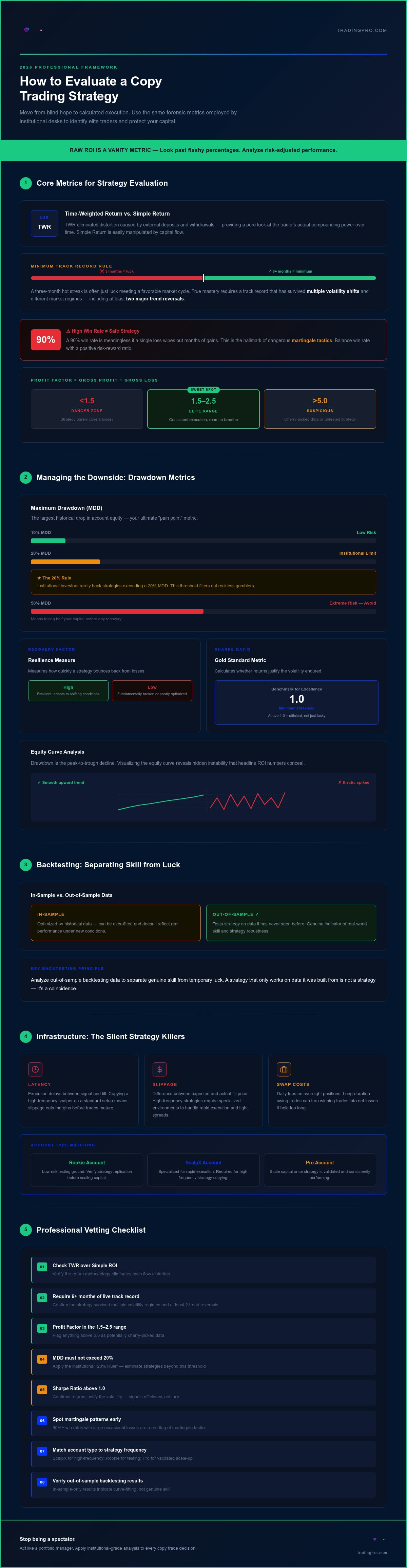
Raw ROI is a vanity metric. It's the ultimate bait for the uninitiated. High returns often hide catastrophic risk levels that lead to total account liquidation. When you learn how to evaluate a copy trading strategy, you must look past the flashy percentages on the social feed. You need to understand the Time-Weighted Return (TWR) instead of the Simple Return. TWR eliminates the distortion caused by external deposits and withdrawals; it provides a pure look at the trader's actual compounding power over time.
Never commit capital to a strategy younger than six months. Survival is the first rule of elite trading. A three month hot streak is often just luck meeting a favorable market cycle. True mastery requires a track record that has survived multiple volatility shifts and different market regimes. If a trader hasn't navigated at least two major trend reversals, they haven't been tested yet.
Don't get obsessed with high win rates. A 90% win rate is meaningless if a single loss wipes out months of gains. This is the hallmark of dangerous martingale tactics. The most sustainable portfolios balance a realistic win rate with a positive risk-reward ratio. This balance is the foundation of institutional-grade copy trading and long-term capital preservation.
The Profit Factor: Measuring Efficiency
Profit Factor is your efficiency engine. It's calculated by dividing gross profit by gross loss. You should aim for the "sweet spot" between 1.5 and 2.5. This range indicates a strategy with enough room to breathe and consistent execution. Be wary of anything above 5.0. Such astronomical numbers usually signal "cherry-picked" data or a strategy that hasn't faced a real market test. Efficiency is about sustainability, not just short-term explosions.
Trade Frequency and Duration
Your chosen strategy must align with your infrastructure. High-frequency strategies require specialized environments like the ScalpX Account to handle rapid execution and tight spreads. If you copy a high-speed scalper on a standard setup, slippage will eat your margins before the trade even matures. Precision in execution is just as vital as the strategy itself.
Analyze average hold times carefully. Swing trading strategies might look profitable, but long-duration trades often carry hidden risks like unrealized swap costs. These daily fees can turn a winning trade into a net loss if the position is held too long. For those just starting, testing these dynamics with a Rookie Account is the smartest move. It allows you to verify how these metrics translate to your actual balance without overexposing your capital.
Managing the Downside: Why Drawdown Defines Your Success
High-performance traders prioritize risk management over profit potential. While most amateurs chase vertical growth, elite professionals focus on Maximum Drawdown (MDD). This is your ultimate "pain point" metric. It reveals the largest historical drop in account equity. If a strategy shows a 50% MDD, it means you must be prepared to lose half your capital before seeing a recovery. Understanding these metrics is essential when learning how to evaluate a copy trading strategy for long-term dominance.
Institutional investors rarely back strategies exceeding a 20% MDD. This "20% Rule" acts as a filter to eliminate reckless gamblers. You must also analyze the Recovery Factor. This measures how quickly a strategy bounces back from its losses. A high Recovery Factor suggests a resilient methodology that adapts to shifting market conditions. A slow recovery indicates a strategy that may be fundamentally broken or poorly optimized for current volatility.
The Sharpe Ratio: Risk-Adjusted Performance
The Sharpe Ratio is the gold standard for institutional quality. It calculates whether a trader's returns justify the volatility they endure. A Sharpe Ratio above 1.0 is your benchmark for excellence. It proves the trader isn't just lucky; they are efficient. For those seeking broader context, the SEC investor guidance on evaluating investment products highlights why risk assessment is the cornerstone of any sophisticated portfolio. Comparing a high-ROI strategy with high volatility against a stable-growth strategy with a superior Sharpe Ratio often reveals that the latter is the safer, more profitable long-term bet.
Equity Curve Analysis
Drawdown is the peak-to-trough decline during a specific period. Visualizing this on an equity curve provides the visual DNA of a trader's performance. You want to see smooth, upward slopes. Beware of "staircase" patterns where long periods of stagnation are followed by sudden, vertical drops. These often signal Martingale traps, where a trader doubles down on losing positions to hide a failing strategy. These curves look like a straight line until they suddenly collapse to zero.
Protect your capital by setting hard equity stop-losses. If you're using a Rookie Account, this is your primary shield against strategy failure. Never allow a master trader to dictate your total risk exposure. Secure your position by opening an account and setting your own safety parameters before the next market move.
Backtesting an Automated Strategy: Separating Skill from Luck
Backtesting an automated strategy is your forensic audit. It involves running a strategy's core logic against historical price data to verify its robustness across different market regimes. This process is non-negotiable for anyone serious about how to evaluate a copy trading strategy with institutional precision. Without a backtest, you are merely hoping that a trader's recent success wasn't a statistical fluke. You need to know how the logic behaves when the market isn't doing them any favors.
Modeling Quality is the first metric you must inspect in any technical report. If a report shows less than 90% modeling quality, the data is incomplete. You should demand 99% or "Every Tick" precision. This ensures the backtest accounted for every price movement, including the volatile spikes that occur during major market crashes. High-quality data is the only way to see if a strategy survives a black swan event or if it evaporates under pressure. It's the difference between a strategy that works in theory and one that survives the reality of the live feed.
Elite developers use a split-data approach to avoid self-deception. They use "In-sample" data to build the strategy and "Out-of-sample" data to test it. If a strategy looks like a hero in the first half but fails in the second, it is over-optimized. It was built to fit the past, not to trade the future. This distinction is the secret to spotting "over-optimized" strategies that look perfect on paper but fail the moment they hit your live account.
Curve Fitting and Over-Optimization
Curve fitting is the most common way traders cheat their results. They tweak parameters until the equity curve is a perfect diagonal line. This is a massive red flag. If a strategy shows zero losing months over a five-year period, it is likely a victim of over-optimization. A "Forward Walk" test is the antidote. It verifies if the logic holds up on unseen data as time progresses. If the performance degrades significantly during the forward walk, the strategy is a house of cards.
Monte Carlo Simulations
Monte Carlo simulations provide the ultimate stress test for your capital. By shuffling the order of historical trades 1,000 times or more, you can determine the "Probability of Ruin." Even a winning strategy can fail if a specific sequence of losses occurs. You must know the worst-case scenario before you commit a single dollar. Use the TradingPRO Trade Hub tools to run these simulations and refine your expectations. This level of analysis separates the professional portfolio managers from the market casualties.
Infrastructure and Execution: The Silent Strategy Killers
Execution speed is the boundary between profit and loss. You can master how to evaluate a copy trading strategy on paper, but if your infrastructure lags, your results will diverge from the master trader. The Latency Gap is real. Even a few hundred milliseconds of delay can cause you to enter a position at a significantly worse price than the professional you follow. This difference, known as slippage, is the silent killer of social trading returns. It turns winning trades into break-even sessions and small losses into account-draining events.
Reliable replication requires access to elite liquidity providers. When a master trader opens a position, your broker must match that order instantly within a deep liquidity pool. Without this institutional-grade backbone, your entry prices will constantly lag behind the source. This is particularly dangerous for high-frequency strategies where profit targets are narrow. You aren't just copying a trader; you're leveraging the engine behind them. If the engine is slow, the strategy is useless.
Broker Selection and Execution Speed
ECN-style execution is mandatory for any serious participant. It ensures your orders go directly to the market without dealer intervention. At TradingPRO, we prioritize institutional-grade execution speed to minimize the gap between the master and the copier. Spreads matter just as much as speed. Over hundreds of trades, even a fraction of a pip in extra spread can be the difference between a growing equity curve and a stagnant one. Positioning yourself with a high-performance partner is a strategic necessity for long-term success.
Account Tiering for Strategy Optimization
Your account type must match the strategy's DNA. High-speed scalpers demand the specialized ScalpX infrastructure to maintain their edge. Using a standard account for a high-frequency strategy is a recipe for failure. The technical overhead and wider spreads will simply be too high for the strategy to remain profitable in your environment. Precision requires the right tools for the specific job.
Smart investors start with a Rookie Account to verify replication accuracy with minimal risk. It's the perfect environment to audit slippage and latency before scaling to Pro or Scalp tiers. Ensure your leverage settings mirror the master trader exactly. Misaligned leverage is a fast track to premature margin calls, even if the master trader remains profitable. Take control of your execution environment and register your professional account today to begin replicating with precision.
Implementation: Your 5-Minute Setup for Strategy Replication
Execution is where ambition meets reality. You've mastered the forensic audit; now you must implement with precision. Follow this streamlined workflow to activate your high-performance portfolio in minutes. Learning how to evaluate a copy trading strategy was the first step. Now, you must apply that knowledge to your live environment.
First, audit the Master Trader using the core metrics established in Section 1. If the strategy age is under six months or the Profit Factor sits outside the 1.5 to 2.5 range, move on. Second, review backtesting reports to ensure the logic survives various market cycles. Third, choose your allocation style. Fixed Ratio provides steady growth, while Proportional settings mirror the Master's risk profile exactly.
Fourth, set an emergency equity stop-loss. This is your institutional safety net. It protects your total balance from unforeseen volatility. Finally, commit to a monthly rebalance. Success in social trading isn't "set and forget"; it's about active management and removing underperformers before they erode your gains. Efficiency is the hallmark of an elite trader.
Portfolio Diversification Strategies
Never put 100% of your capital behind a single strategy. Elite investors build a balanced ecosystem. Combine a Trend-Following Master with a Range-Bound specialist to ensure performance across all market conditions. When one strategy stalls in a sideways market, the other should capitalize on the momentum. Regularly rebalance your winners. Taking profit from your copy portfolio and reallocating to emerging strategies ensures your capital is always working at peak efficiency. This modular approach is how you scale toward institutional status.
Continuous Monitoring and Red Flags
Vigilance is the price of dominance. Watch for Style Drift. This occurs when a Master Trader abandons their proven logic for high-risk gambles. Sudden changes in trade frequency or volume are immediate red flags. If a scalper suddenly starts holding positions for days, they've lost their edge. Understanding how to evaluate a copy trading strategy means knowing when to cut ties. Stop copying the moment the execution deviates from the original audit. Don't wait for a drawdown to tell you what the metrics already revealed.
Ready to dominate? Register your TradingPRO account now and start building your elite portfolio.
Dominate the Market with Institutional Precision
You've moved beyond the surface level. You now possess the framework to dismantle flashy leaderboards and identify true market mastery. By prioritizing risk-adjusted returns and forensic backtesting, you've shifted from a spectator to a sophisticated portfolio manager. Mastering how to evaluate a copy trading strategy is your ultimate competitive advantage in a fast-moving landscape. It's about protecting your capital while aggressively pursuing elite growth.
Precision is nothing without the right engine. TradingPRO delivers institutional-grade execution speed to ensure minimal slippage and Red Dot-level precision in every replication. You aren't just copying; you're executing with a global leader that provides negative balance protection for all Rookie and Pro accounts. This creates a secure environment where performance is the only priority. You have the metrics, the logic, and the infrastructure to excel.
Join the Elite: Register Your TradingPRO Account and Master Social Trading today. The path to consistent, professional-grade results is open. Take the lead and build your legacy.
Frequently Asked Questions
What is the most important metric when evaluating a copy trading strategy?
Maximum Drawdown (MDD) is the most critical metric because it defines your absolute risk exposure. While raw ROI attracts attention, MDD reveals the depth of the equity valley you must survive to reach those peaks. When you learn how to evaluate a copy trading strategy, you must also prioritize the Sharpe Ratio. This institutional benchmark proves whether a trader's returns result from genuine skill or just reckless, unmanaged volatility.
How much capital do I need to start copy trading on TradingPRO?
You can begin your journey with a Rookie Account, which is designed specifically for those testing the waters of social trading. TradingPRO offers multi-tiered infrastructure including Micro, Pro, and Scalp accounts to suit various capital levels and professional styles. This flexibility ensures you can scale your portfolio at your own pace while utilizing our institutional-grade execution environment. Specific minimums vary by account tier and are visible during the registration process.
Can I lose more than my initial deposit while copy trading?
No, you are protected by our negative balance protection policy. This safeguard ensures that your trading losses will never exceed your initial deposit, providing a secure safe-haven for your capital. Whether you use a Rookie or Pro account, this feature acts as a definitive shield against market gaps and extreme volatility. It allows you to pursue ambitious growth goals with the confidence that your liability is strictly limited to your account balance.
How do I know if a Master Trader is using a high-risk Martingale strategy?
Look for a staircase equity curve characterized by long periods of steady growth followed by sudden, vertical drops. This pattern often reveals a trader doubling down on losing positions to avoid realizing losses. You should also audit their trade history for increasing lot sizes during losing streaks. A sustainable strategy maintains consistent risk management, whereas Martingale tactics are a ticking time bomb that eventually leads to total account liquidation.
What is the difference between backtesting and forward testing?
Backtesting runs a strategy's logic against historical price data to verify how it would have performed in the past. Forward testing involves running that same logic in a live or demo environment to see how it handles current market conditions. Both are essential components of how to evaluate a copy trading strategy. Backtesting provides the statistical foundation, while forward testing confirms the strategy remains effective in the present high-speed trading landscape.
How often should I review and rebalance my copy trading portfolio?
We recommend a comprehensive review and rebalancing of your copy portfolio at least once a month. This cadence allows you to identify underperforming traders or style drift before they impact your long-term success. During these sessions, you should reallocate capital from stagnant strategies to those showing consistent, risk-adjusted growth. Active management is the hallmark of a professional trader; it ensures your capital is always working at peak efficiency and precision.
Does execution speed really matter if I am copying a swing trader?
Execution speed remains vital even for swing strategies. While the impact is more pronounced for scalpers, slippage on a swing trade can still degrade your entry price and eat into your total profit margins. TradingPRO provides institutional-grade infrastructure to ensure every replicated trade happens with Red Dot-level precision. Minimizing the latency gap ensures your account results mirror the Master Trader as closely as possible, preserving the integrity of the original strategy.
Is backtesting an automated strategy 100% accurate for future results?
No backtest can guarantee future performance with absolute certainty. Market regimes shift, and what worked in a trending market may fail during a period of consolidation. However, a high-quality backtest with 99% modeling quality provides the statistical evidence needed to separate skill from luck. It acts as a stress test for the strategy's logic, giving you the confidence to deploy capital while remaining vigilant for any changes in live performance trends.


