




- Published on: 2026-08-04 10:14:09
How to Start a Trading Journal: 2026 Performance Guide
The most profitable asset in your 2026 portfolio isn't a specific stock or a high-leverage token. It's the raw data hidden within your own execution history. Most traders feel like they're spinning their wheels, repeating the same emotional mistakes despite having a clear strategy. You've likely felt that frustration. It's the gap between knowing what to do and actually executing it under pressure. Mastering how to start a trading journal is the single most effective way to bridge that gap and move from amateur guesswork to institutional-grade precision.
This guide delivers a high-performance blueprint to build a data-driven routine that eliminates data entry overwhelm. We'll show you how to gain absolute clarity on your strategy win-rates while stripping the emotion out of every trade. You're about to transform your past performance into a repeatable roadmap for future success. Let's build the infrastructure that separates the elite professionals from the struggling rookies. By the end of this guide, you'll have a streamlined system designed for speed and professional-grade execution.
Key Takeaways
- Treat your journal as a professional telemetry system to finally distinguish market luck from genuine trading skill.
- Identify non-negotiable context metrics, such as market regime and volatility, to provide a clear blueprint for strategy refinement.
- Master the 5-step protocol on how to start a trading journal that integrates seamlessly with your high-speed execution routine.
- Select the right infrastructure for your account tier, ensuring your data entry process matches your specific trading frequency and speed.
- Leverage your journaled performance to transition into a Social Trading master, attracting copiers with a transparent and consistent track record.
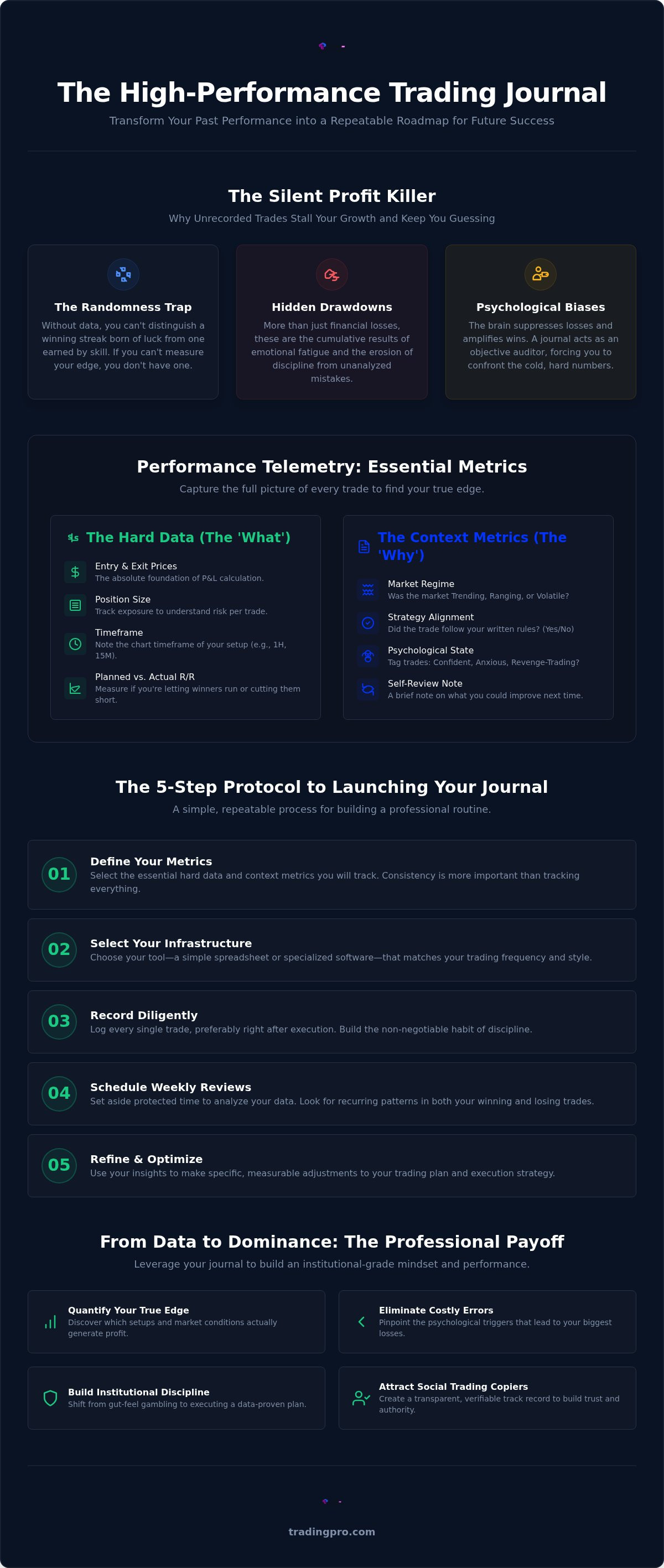
The Silent Profit Killer: Why Unrecorded Trades Stall Your Growth
Your trading history contains a goldmine of data, yet most retail traders treat their past execution like a discarded receipt. This is a fatal mistake. A trading journal is not a reflective diary or a collection of casual notes; it is a professional-grade telemetry system designed to monitor the health of your strategy in real-time. Mastering how to start a trading journal is the first step toward institutional stability. Without this data, you fall into the "Randomness Trap." You cannot distinguish a winning streak born of pure luck from one earned through high-probability Day trading strategies. If you can't measure your edge, you don't have one. You are simply guessing in a high-stakes environment where the house always has more data than you.
The Psychology of the Unwritten Trade
The human brain is hardwired to protect the ego. It naturally suppresses the memory of losing trades while amplifying the glory of wins. This selective memory creates a distorted reality where you believe you're a better trader than your balance suggests. A journal acts as an objective third-party auditor for your mind, forcing you to confront the cold, hard numbers. Hindsight Bias is the psychological tendency to believe an event was predictable after it has already occurred, leading traders to overestimate their analytical accuracy and ignore systemic flaws. By documenting every entry, you eliminate the "I knew that would happen" fallacy and start focusing on what you actually saw in the moment.
Moving from Amateur to Institutional Mindset
Amateurs trade like gamblers, relying on gut feelings and unverified patterns. Professionals operate with institutional precision, treating every execution as a data point. You build an "Execution Edge" through constant self-review and the relentless optimization of your process. This mindset shift is the difference between a hobby and a career. If you're just beginning this journey, review our Forex Trading for Beginners Guide to establish the technical foundation required for professional journaling. Precision execution starts with precision recording. There is no room for hesitation; either you track your progress or you accept your stagnation.
Performance Telemetry: Essential Metrics for Your 2026 Journal
Precision is the hallmark of the professional. To move beyond the amateur ranks, you must view your journal as a high-performance telemetry system. It isn't enough to record that you bought a certain pair at a certain price. You need to capture the environmental variables that influenced the outcome. This starts with the non-negotiable hard data: Entry and Exit prices, exact Position Size, and the specific Timeframe of your setup. However, the elite edge is found in "Context Metrics." You must identify the market regime. Was the market Trending, Ranging, or Volatile? A strategy that prints money in a trending market might be a liability during low-volume consolidation. Understanding how to start a trading journal effectively means categorizing these regimes to filter out low-probability environments.
Equally critical is "Strategy Alignment." Every entry must be tagged with a simple binary: Did this trade follow your written rules? If the answer is no, the profit is irrelevant. It was a mistake. By documenting your psychological state, you turn your journal into a sophisticated psychological tool. Tagging trades with states like "Confident," "Anxious," or "Revenge-Trading" reveals the hidden patterns that lead to blowups. When you see that 80% of your losses occur when you're feeling "Anxious," you've identified a specific performance bottleneck that no technical indicator could ever reveal.
The Hard Data: Quantifying Your Edge
Institutional success is built on the math of expectancy. You must track your Risk/Reward (R/R) ratios with absolute transparency. Compare your "Planned R/R" against your "Actual R/R." If you consistently plan for 3:1 but exit at 1:1 due to fear, your data will highlight this leak. For high-frequency traders, tracking slippage and execution speed is vital. This is especially true for those using ScalpX accounts, where every millisecond and pip impacts the bottom line. Expectancy is your ultimate metric. It tells you exactly how much you can expect to make for every dollar risked over a large sample size. If your expectancy is positive, you have a business. If it's negative, you have a hobby.
The Soft Data: Tracking the Human Element
Technical setups are only half the battle. Your "Pre-trade Conviction" score, rated on a scale of 1 to 10, often predicts performance better than the chart itself. High-conviction trades that fail suggest a blind spot in your analysis. Low-conviction trades that you take anyway suggest a lack of discipline. Use "Mistake Tags" like FOMO or Early Exit to quantify your behavioral errors. Pair these tags with trade screenshots for visual pattern recognition. Seeing the setup through the lens of your past mistakes creates a frictionless path to improvement. Once you're ready to apply these elite standards to live markets, you can open your account and start building your track record today.
Mastering how to start a trading journal isn't about looking back. It's about looking forward with better data. Use these metrics to build a repeatable routine that turns every market session into a masterclass in execution.
Choosing Your Infrastructure: Digital vs. Manual Journaling
Your strategy is only as good as the infrastructure you use to measure it. In the high-velocity markets of 2026, the "Old School" approach of physical notebooks is often too slow and inefficient. Hand-writing entry prices while a volatile asset moves fifty pips is a recipe for inaccuracy. While physical journals can offer a tactile sense of reflection, they lack the computational power to identify complex correlations. If you want to understand the true benefits of a trading journal, you must prioritize speed and scalability. Manual notebooks fail to provide the instant feedback loops required for modern execution.
Spreadsheets like Excel or Google Sheets offer a middle ground with maximum customization. You can build bespoke formulas to track specific variables that off-the-shelf software might miss. However, the manual entry friction remains a significant bottleneck. Every second spent typing data is a second lost in market analysis. For those seeking a professional-grade alternative, the TradingPRO Trade Hub provides a modern performance monitoring solution. It bridges the gap between raw data and actionable insight, allowing you to focus on execution rather than data entry. Deciding how to start a trading journal depends entirely on your need for speed and the complexity of your strategy.
When to Use Automated Solutions
High-frequency scalpers are the primary beneficiaries of automation. When you're executing dozens of trades per session, manual logging is impossible. Automated journaling software utilizes seamless API integrations to pull your execution data in real-time. API-linked journals eliminate human entry error by pulling raw execution data directly from the server. However, you must guard against "Data Overload." Automated tools can generate hundreds of metrics, but they only provide value if you focus on the three or four that actually impact your bottom line. Use automation to handle the heavy lifting of data collection, but keep your focus on the insights that drive profitability.
The Hybrid Approach for Rookie Traders
For those just learning how to start a trading journal, a hybrid model is often the most effective path to growth. Use automated data collection for hard metrics like entry price, slippage, and R/R ratios. Pair this with manual entry for your psychological notes and market context. This combination ensures absolute accuracy for your numbers while forcing the self-reflection necessary to fix behavioral leaks. It's the most efficient way to build a professional-grade track record without becoming overwhelmed by administrative tasks. You can Register for a Secure Account today to begin testing these tools in a live environment. Accuracy in your records leads directly to confidence in your execution.
The 5-Step Protocol to Launching Your Journal Today
Success in the markets isn't about intuition; it's about a repeatable process. To move from a struggling rookie to a consistent professional, you need a system that captures data without slowing down your execution. This 5-step protocol is designed to help you master how to start a trading journal that actually makes you money. Stop treating your trades like random events. Start treating them like business transactions. Precision in your record-keeping leads directly to precision in your profits.
- Step 1: Define Your "Why" and Platform. Match your journaling tool to your execution speed. If you are scalping, you need automated API feeds to keep pace. If you are swing trading, a customized spreadsheet offers deeper reflection.
- Step 2: Select 5 Core Metrics. Don't drown in data. Focus on what moves the needle: Entry/Exit, Risk/Reward, Market Regime, and Strategy Alignment.
- Step 3: Perform the "Pre-Flight Check." Record your conviction level on a scale of 1 to 10 before you click buy. This simple act of documentation creates a psychological speed bump that prevents impulsive, low-quality entries.
- Step 4: Execute the "Post-Mortem." Document the exit and your immediate emotional reaction. Emotions are fleeting; capturing them while they are raw is the only way to identify and fix behavioral leaks.
- Step 5: Conduct the "Weekly Performance Audit." Every weekend, review your data to identify "Strategy Drift." Are you still executing the same edge you defined on Monday, or has your discipline eroded as the week progressed?
Building the Habit of Consistency
The biggest hurdle in learning how to start a trading journal is maintaining the habit. Use the "2-Minute Rule": if an entry takes longer than 120 seconds, your system is too complex. Strip away the fluff and focus on high-impact data. Set "Audit Appointments" in your calendar for Saturday mornings to review your weekly performance without the pressure of live candles. You must journal your losers even more meticulously than your winners. Profits often mask poor execution, but your losses contain the blueprint for your next breakthrough. Discipline is built in the spreadsheets, not just on the charts.
Reviewing Your Data Like a Pro
Institutional traders look for "Strategy Leakage," which refers to areas where you are losing money despite following your rules perfectly. This often happens when market regimes shift and your strategy loses its environmental fit. Look for "Time-of-Day" patterns in your journal. You might discover that you are highly profitable during the London session but consistently give back gains during the New York open. Identifying these windows of peak performance allows you to trade less and earn more. Check out our guide on the Best Broker for Rookie Traders to see how documented performance leads to account tier upgrades and better execution conditions. Ready to put this protocol into action? Register for your account and start building your professional track record today.
Beyond the Diary: Leveraging Data for Social Trading Success
A meticulous journal is no longer a private exercise; it is the foundation of your professional reputation in the global marketplace. In 2026, your data is your resume. Mastering how to start a trading journal provides the transparency that elite investors demand before they allocate capital to your strategy. You aren't just recording trades for self-improvement. You're building a verified track record that can be audited by the entire Social Trading ecosystem. This transparency is what separates a hobbyist from a Master. It turns your execution into a scalable product.
Every professional journey has a starting point. For most, the transition begins with a Rookie Account. By journaling every entry at this stage, you build the discipline required to manage larger capital pools later. You move from being a solo participant to becoming a signal provider. Your journal serves as the ultimate tool for strategy transparency, proving to the world that your results are the product of a repeatable process rather than a string of lucky guesses. Consistency is the only currency that matters in a high-stakes environment.
Attracting Copy Traders with Data
Investors in the social space prioritize stability over sporadic windfalls. A "Low Drawdown" profile is consistently more attractive to serious copiers than "High Returns" accompanied by massive volatility. Your journal data allows you to quantify this stability. Use your recorded insights to write compelling strategy descriptions that explain the "why" behind your performance. When potential followers see that you have a documented plan for every market regime, their confidence in your execution skydives. Review our guide on Social Trading vs Copy Trading to understand how your journaled data fits into the wider mirror-trading landscape. Data is the bridge between your skill and their capital.
The 2026 Vision: Your Journal as a Business Asset
Frame your trading history as a high-value business asset. A multi-year track record backed by deep journaling can attract institutional interest and open doors to advanced partnerships. This is about total market dominance. You've learned how to start a trading journal and integrated it into your daily routine; now, it's time to leverage that discipline for maximum growth. The journey from manual data entry to global signal provider is fast-paced but rewarding. Take the first step toward professional-grade execution today. Start your journey with a TradingPRO Deposit Bonus and build a journal that reflects your ambition. Your future self will value the data you record today as the blueprint for your institutional-grade success.
Scale Your Edge with Institutional Precision
Mastering how to start a trading journal is the bridge that leads you from guesswork to becoming a scalable signal provider in the global Social Trading ecosystem. Leverage our multi-tiered infrastructure, including Rookie, Micro, Pro, and Scalp accounts, to find the perfect fit for your growth stage. Use our advanced Trade Hub monitoring tools to turn every execution into a lesson in excellence. Your track record is your resume. Build it with the same tools the professionals use every day.
Launch Your Professional Trading Journey with a TradingPRO Rookie Account and transform your data into a repeatable roadmap for success. The markets move fast. Don't let your edge disappear into unrecorded history. Take command of your performance today.
Frequently Asked Questions
How much time should I spend on my trading journal every day?
Limit your active journaling to 5 minutes per trade and 20 minutes for a nightly wrap-up. Consistency is more important than length. If your process takes too long, you won't stick with it. Use the "2-Minute Rule" mentioned earlier to keep entries punchy and focused on high-impact variables. Efficiency ensures your journal remains a tool for performance rather than an administrative burden.
What is the best software for a beginner trading journal in 2026?
The best software for 2026 prioritizes speed and API connectivity. For those just learning how to start a trading journal, the TradingPRO Trade Hub provides a frictionless experience by automating raw data entry. This allows you to focus on high-level analysis rather than manual logging. Beginners should look for platforms that offer clear visual dashboards and easy tagging systems to identify strategy win-rates.
Can I just use my broker’s built-in trade history as a journal?
No. Broker history is a record of your past, but a journal is a blueprint for your future. Built-in history lacks the "Soft Data" like market context, psychological state, and strategy alignment. Without these variables, you can't distinguish a lucky win from a skilled execution. Professional traders use history as a starting point and then add the layers of analysis that a broker simply doesn't provide.
Should I include my losing trades in my journal?
Documenting your losing trades is mandatory for anyone serious about professional-grade execution. Losses contain the specific data points needed to identify strategy leaks and behavioral errors. While winning trades protect the ego, losing trades protect the account balance. Treat every loss as a high-value lesson. If you omit losers, your data becomes skewed and your performance audits will lead to incorrect conclusions about your edge.
How often should I review my past journal entries?
Schedule a weekly performance audit every weekend and a comprehensive strategy review once a month. Weekly reviews help you catch "Strategy Drift" before it erodes your capital. Monthly reviews allow you to see how your edge performs across different market cycles. This rhythmic approach ensures you stay aligned with your long-term goals while making the tactical adjustments necessary for a fast-moving landscape.
What are the most important metrics to track for a scalping strategy?
Scalpers must prioritize execution speed, slippage, and "Planned vs. Actual" exit points. In high-frequency environments, even a half-pip of slippage can impact your expectancy over a large sample size. Tracking these metrics reveals whether your broker is providing the necessary infrastructure for your strategy. It's the difference between a profitable scalp and a break-even trade once commissions and execution delays are factored in.
How do I track my emotions in a trading journal without it feeling weird?
Quantify your emotions using a standardized scale or specific behavioral tags like "FOMO" or "Greed." This removes the subjectivity of long-form writing and turns your feelings into actionable metrics. When you see that 70% of your losses occur when you're feeling "Anxious," you've identified a performance bottleneck. This data-driven approach to psychology is exactly how to start a trading journal that actually improves your bottom line.
Is a physical notebook better than a digital spreadsheet for journaling?
Digital spreadsheets and automated hubs are vastly superior for the 2026 trader. While physical notebooks can help with slow reflection, they can't calculate R/R ratios, filter by market regime, or identify session-specific win-rates. Digital tools offer the speed and analytical power required to compete at an institutional level. Efficiency is the priority. If your journaling system is too slow to keep up with the market, it becomes a liability.


