




- Published on: 2026-09-18 10:15:55
Level 2 Data Explained: Mastering Market Depth for Professional Trading

Most retail traders are flying blind. They react to price movements that have already happened while institutional giants have already positioned their capital. You've likely felt the sting of a sudden reversal or the frustration of a "perfect" setup getting crushed by hidden sell walls. It's a common pain point that stems from watching the scoreboard instead of the playbook. This guide provides the Level 2 data explained simply so you can unlock the market's "X-ray vision."
We'll show you how to read the limit order book and identify exactly where the big money is resting before the price even flinches. You'll stop guessing and start seeing the actual supply and demand dynamics that drive the tape. We'll break down the 2026 SEC round-lot tiers and show you how to use market depth to identify rock-solid support and resistance based on real orders. We're moving beyond the flickering numbers of a standard DOM to give you the institutional-grade precision required for high-performance trading. It's time to trade with the clarity and confidence of a seasoned professional.
Key Takeaways
- Master the "X-ray vision" of the markets by learning how to decode the limit order book and identify where institutional liquidity is truly resting.
- Gain an elite edge with our Level 2 data explained guide, showing you how to spot market manipulation like spoofing and hidden iceberg orders before they impact your P&L.
- Differentiate between Level 1, 2, and 3 data feeds to ensure you have the precise depth-of-book information required for high-frequency execution.
- Learn to identify authentic support and resistance zones by analyzing the real-time balance between bid and ask volumes across multiple price levels.
- Discover why professional infrastructure, such as the TradingPRO Scalp account, is the essential partner for translating market depth insights into lightning-fast trades.
What is Level 2 Data? Beyond the Price Chart
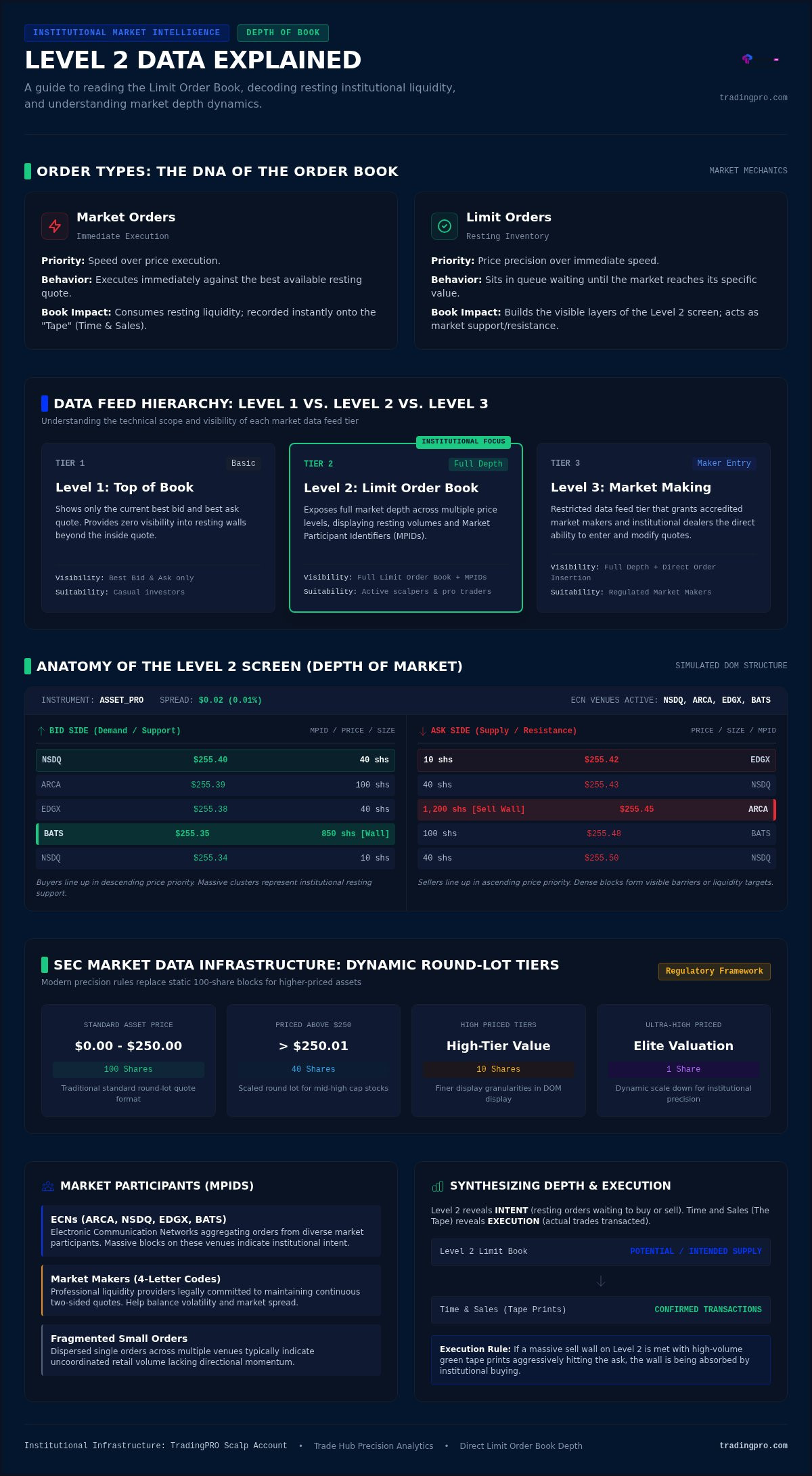
Level 2 data represents the evolution of market transparency. While a standard price chart shows you where the market has been, Level 2 reveals where it's likely going. It provides the full Limit Order Book for a security, exposing the layers of liquidity that remain invisible to the retail crowd. Having Level 2 data explained correctly means recognizing that price action is merely the result of a deeper struggle between resting orders. It reveals the "market depth," showing exactly how many shares or lots are waiting at each price level away from the current quote.
Unlike basic data feeds, Level 2 exposes the Market Participant Identifiers (MPIDs). This allows you to see whether the liquidity is coming from major exchanges like ARCA, NSDQ, or EDGX. This transparency is essential for identifying institutional-grade movements. By watching these identifiers, you can gauge the conviction of the buyers and sellers in real-time, moving beyond the simple "last price" metrics that trap uninformed traders.
The Limit Order Book: The Market's DNA
To understand depth, you must distinguish between market and limit orders. A market order prioritizes speed, executing immediately at the best available price. Conversely, a limit order prioritizes price, sitting in the queue until the market reaches its specific value. These pending limit orders create the visible layers of a Level 2 screen. Understanding order book mechanics and depth is vital because it shows the "resting" volume that acts as a magnet or a barrier for price. The Order Book is the definitive inventory of market intent, representing the collective commitment of traders at every price level.
Why Level 1 Data is Not Enough for Pros
Standard Level 1 feeds only show the "Top of Book," which includes the current best bid and best ask. For a casual investor, this is sufficient. For a professional using a Scalp Account, it's like driving with a blacked-out windshield. You see the road directly in front of you, but you have no idea if a massive sell wall is waiting just two cents higher. This lack of depth leads to getting stopped out by sudden reversals that were actually predictable.
Level 2 provides the "why" behind sudden price movements. When price hits a level and bounces violently, Level 2 often shows a massive cluster of orders that were sitting there for minutes or hours. Trading without this depth means you're trading blind to institutional footprints. By utilizing the advanced tools in the Trade Hub, you can spot these supply and demand imbalances. This Level 2 data explained framework allows you to position yourself alongside the smart money rather than against it, ensuring your execution is as precise as the data you're reading.
Decoding the Level 2 Screen: Bids, Asks, and Sizes
Level 2 data explained properly involves more than just identifying price. It requires a surgical dive into the columns that define market structure. The Bid column lists the prices where buyers are queuing to enter. The Ask column displays the wall of sellers waiting to exit or initiate shorts. Between them sits the spread. This is where the battle for direction happens. If you don't understand the participants in these columns, you're just guessing at the next move.
The "Size" column is where you distinguish institutional whales from retail minnows. Under the SEC market data infrastructure rules, these sizes are now more precise and dynamic. For stocks priced over $250, round lots are no longer a flat 100 shares. They scale down to 40, 10, or even 1 share for high-priced assets. This means the "flickering numbers" in your DOM represent actual intent at specific tiers. You must watch these volume clusters to identify where the "big money" is truly resting before the price reaches those levels.
Understanding Market Participants
Market Participant Identifiers (MPIDs) reveal who is providing the liquidity. Electronic Communication Networks (ECNs) like ARCA, NSDQ, and BATS represent aggregated orders from various traders. Market Makers, identified by unique four-letter codes, are the professional liquidity providers obligated to maintain a two-sided market. Recognizing these players allows you to filter out retail noise. When you see a massive block on a major ECN, you're likely looking at institutional intent. Conversely, fragmented small orders across multiple venues often signal retail activity that lacks directional conviction.
Reading the 'Tape' (Time and Sales)
Level 2 shows you intent. Time and Sales shows you execution. You must synthesize these two feeds to succeed in high-stakes environments. If you see a massive sell wall on Level 2 but the "Tape" shows aggressive green prints hitting the ask, that wall is being liquidated. That's a bullish signal. Using the TradingPRO Trade Hub, you can merge these data streams into a single, actionable view of market momentum. It's the ultimate way to spot the difference between a real barrier and a fake one.
Aggressive buyers don't wait in the Level 2 queue. They cross the spread and hit the ask immediately. Passive buyers wait for the price to come to them. By comparing the resting volume on Level 2 with the actual trades on the tape, you can spot "iceberg" orders or fake walls designed to manipulate sentiment. This level of insight separates professionals from the herd. Secure your advantage and open your account to start trading with institutional-grade depth today.
Level 1 vs. Level 2 vs. Level 3: Which Do You Need?
Choosing your data tier is the first strategic decision you'll make as a trader. The difference between success and failure often lies in the granularity of the information on your screen. While Level 1 provides a snapshot of the current state, Level 2 offers a deep dive into the market's trajectory. Understanding Level 2 data explained in the context of these tiers helps you select the infrastructure that matches your ambition. Don't settle for the surface when the real opportunities reside in the depths.
Level 1: The Retail View
Level 1 is the retail baseline. It provides the absolute minimum information required to place a trade: the last price, the best bid, and the current ask. This tier is perfectly suitable for Rookie Account holders who are focusing on long-term trends or swing trading. However, Level 1 has severe limitations in fast-moving environments. It hides the "why" behind price action, leaving you vulnerable to sudden volatility spikes in emerging markets where liquidity can vanish in milliseconds.
Level 2: The Scalper’s Edge
Level 2 is the professional gold standard. It grants you insight into 5 to 20 levels of price depth, revealing the massive orders waiting just outside the current spread. This is where you spot liquidity "vacuums." These are gaps in the order book where a lack of resting orders allows the price to rocket or plummet with minimal effort. For anyone using ECN accounts for day trading, Level 2 visibility is non-negotiable. It allows you to front-run momentum and exit before a reversal hits the tape. This hierarchy is built upon complex central limit order book operations that prioritize orders based on price and time, and Level 2 is your window into that engine.
Level 3 takes this transparency a step further but remains restricted. Only registered Market Makers have Level 3 access, which allows them to enter, adjust, and cancel quotes directly on the exchange. For the retail professional, Level 2 provides all the necessary intelligence to compete at an institutional level. However, remember that data is only as valuable as your ability to act on it. In high-volatility markets, execution speed matters more than your data tier. This is why TradingPRO prioritizes ultra-low latency infrastructure, ensuring that once you spot an opportunity on your Level 2 screen, your trade hits the matching engine instantly. Precision and speed are the two pillars of peak performance.
Practical Trading Strategies Using Level 2 Data
Knowledge without execution is a liability. To dominate the tape, you need an actionable playbook that translates flickering numbers into profitable entries. This Level 2 data explained section moves beyond theory into the high-stakes tactics used by elite desks. You aren't just watching the market; you're reading the psychology of every participant in the queue. Master these strategies to stop guessing and start anticipating.
Level 2 allows you to confirm breakouts with surgical precision. A price move on a chart is just a line. On a depth ladder, a breakout is only valid if you see the ask side thinning out while the bid side stacks with aggressive buyers. If the price hits a new high but the ask side remains heavy with massive sell orders, the move lacks conviction. Use depth to filter out these "fakeouts" and only commit capital when the path of least resistance is clear.
Scaling out of positions is equally critical. Professional traders use market depth to find the best exit prices without causing slippage. By identifying where the largest clusters of resting buy orders are located, you can feed your sell orders into that liquidity. This ensures you get filled at your target price even in fast-moving environments. It is the difference between a clean exit and watching your profits evaporate as you chase the bid down.
Identifying Market Manipulation
Spoofing is a predatory tactic you must recognize immediately. It involves placing massive limit orders with no intention of execution. These "fake walls" are designed to scare retail traders into selling, allowing the manipulator to buy at a lower price. Spot the bluff by watching the order's behavior as price approaches. If a 50,000-share sell wall suddenly vanishes just before the price hits it, you've identified a spoof. Attack the spread when these walls disappear; it's often a signal of an imminent upward surge.
Finding hidden support through "Iceberg" orders is another professional edge. An iceberg order is a large institutional trade broken into small, visible pieces to hide the true size. If you see the price hitting the same bid level repeatedly and the size never decreases despite heavy selling on the tape, you've found an iceberg. This level represents rock-solid support where "big money" is absorbing every share available.
Liquidity Pockets and Price Magnets
Price is naturally drawn toward large areas of resting liquidity. These clusters act as magnets, pulling the price toward them before a potential reversal. By using the DOM (Depth of Market), you can predict short-term reversals by identifying where these liquidity pockets end. When the price "cleans out" a massive pocket of orders and hits a vacuum of low volume, the momentum often stalls. This is your cue to exit or scalp a reversal. Combining these insights with the lightning-fast execution of a Scalp Account allows you to capitalize on these micro-movements with institutional-grade precision. Stop being the liquidity for others. Register your account now and start trading with the transparency you deserve.
Institutional Infrastructure: Why TradingPRO is Your Edge
Having Level 2 data explained is the first step toward professional mastery, but data is only as powerful as the infrastructure behind it. In the high-velocity world of day trading, a millisecond of lag can turn a winning setup into a slippage-riddled loss. You need more than just a window into the order book. You need an ultra-low latency environment that ensures your orders hit the matching engine before the liquidity vanishes. TradingPRO provides this institutional-grade stability, allowing you to act on market depth with absolute confidence.
Our multi-asset infrastructure is built with 2026-ready technology, designed to handle the massive data bursts of modern markets. Whether you are identifying support walls or spotting spoofing attempts, our platform delivers the speed required to capitalize on those insights. This isn't just about seeing the market. It's about dominating it through superior execution and a "safe-haven" environment that prioritizes your success.
Scalp and Pro: Engineered for Performance
High-frequency traders and seasoned scalpers require a specific type of environment. Our Scalp Account tier is specifically engineered for this purpose. It provides a direct market access feel that eliminates unnecessary middlemen, putting you as close to the exchange liquidity as possible. By pairing Level 2 visibility with our optimized execution paths, you can enter and exit positions with the precision of an institutional desk. If you're ready to move beyond basic retail limitations, register for a Scalp Account today and experience the difference of professional-grade speed.
Empowering the Modern Trader
The journey from a Rookie Account to a professional mindset requires the right tools and a commitment to excellence. As you master the nuances of the order book, our tiered account structure grows with you. For those who prefer a collaborative approach, our institutional-grade social trading ecosystem allows you to replicate the trades of professionals who have already mastered order flow. This isn't just a platform; it is a facilitator for your financial evolution.
TradingPRO acts as your sophisticated partner in a fast-moving landscape. We provide the tools, the depth, and the confidence you need to excel. Don't let inferior technology hold back your potential. Join the elite and start trading with institutional-grade infrastructure to secure your competitive advantage in the global markets. The future of your trading career starts with the right foundation.
Dominate the Tape with Institutional Precision
Mastering market depth is the definitive line between retail guesswork and professional mastery. You now understand that price action is merely the surface of a much deeper struggle. By identifying institutional intent and spotting manipulation before it hits your P&L, you've gained the "X-ray vision" required for consistent success. This Level 2 data explained framework is your foundation for a more precise, data-driven approach to every trade.
Insight is only half the battle. To win in high-volatility environments, your execution must be as sharp as your analysis. TradingPRO provides the cutting-edge environment you need to thrive. As the 2026 High-Performance Broker of the Year, we offer scalp-tier infrastructure and ultra-low latency execution designed for those who refuse to settle for second best. It's time to stop reacting to the market and start leading it. Open a TradingPRO Scalp Account for Institutional Execution today and join the ranks of elite traders who demand excellence. Your future in the markets starts now.
Frequently Asked Questions
Is Level 2 data worth it for beginner traders?
While beginners often start with a Rookie Account, exploring Level 2 data is vital as you transition into active day trading. It provides a deeper understanding of market mechanics beyond simple price charts. The sheer volume of flickering numbers can be overwhelming initially. It's best used once you've mastered basic technical analysis and are ready to identify institutional footprints to avoid getting stopped out by sudden reversals.
Can I see Level 2 data on a mobile trading app?
Yes, many modern platforms now offer market depth on mobile, though the experience is often condensed. While you can view the top layers of the bid and ask columns, limited screen real estate makes it difficult to track rapid changes in the full limit order book. For professional-grade analysis and high-frequency execution, most traders prefer desktop environments like the TradingPRO Trade Hub to ensure they don't miss critical liquidity shifts.
What is the difference between Level 2 and the Order Book?
Level 2 is the data feed itself, while the order book is the ledger where those orders are organized. Think of the order book as the inventory of all pending limit orders at various price levels. When you access a Level 2 feed, you're viewing a real-time window into that order book. This Level 2 data explained simply allows you to see the depth of market intent across multiple price tiers simultaneously.
How do I identify 'spoofing' in Level 2 data?
You identify spoofing by watching for large orders that are canceled immediately before the price reaches them. These fake orders are placed to manipulate retail sentiment and create a false sense of supply or demand. If a massive sell wall vanishes the moment price gets within a few ticks, it was likely a spoof. These tactics are designed to drive prices lower so the manipulator can buy at a discount.
Do all brokers provide Level 2 data for free?
No, Level 2 data availability and pricing vary significantly across the industry. While some retail brokers bundle Nasdaq TotalView for a small monthly fee or offer it free to high-volume clients, professional-grade feeds often require a separate subscription. This is due to the exchange fees charged by venues like the NYSE and Nasdaq. Professional traders typically look for brokers who provide deep liquidity and low-latency access to justify these costs.
What are MPIDs and why should I care about them?
Market Participant Identifiers (MPIDs) are four-letter codes that show which exchange or market maker is providing the liquidity. Identifiers like NSDQ, ARCA, or EDGX tell you where the orders are coming from. You should care about them because they help you distinguish between high-conviction institutional blocks and fragmented retail noise. Seeing a major exchange holding a price level gives you more confidence in a potential support or resistance zone.
How does Level 2 data help with forex scalping?
Level 2 data is essential for forex scalping because it reveals liquidity depth in a decentralized market. By using a Scalp Account with depth-of-market capabilities, you can spot where large clusters of orders are resting. This allows you to enter and exit trades with minimal slippage. It also helps you identify liquidity vacuums where price might move rapidly due to a lack of resting orders, giving you a significant timing advantage.
Does Level 2 show hidden or 'dark pool' orders?
No, Level 2 data only shows "lit" or visible liquidity on public exchanges. Hidden orders, such as icebergs or trades happening in dark pools, don't appear in the visible size column. However, you can often deduce their presence by watching the Time and Sales window alongside the order book. If the price isn't moving despite a massive visible order being hit, an iceberg order is likely absorbing the volume behind the scenes.


