




- Published on: 2026-09-18 07:39:38
Order Book Trading Strategies: Mastering Market Depth for Elite Execution in 2026

Stop trading based on where the price was and start trading based on where the liquidity is. Most market participants are liquidated by noise because they can't see the institutional machinery moving beneath the surface. You've likely felt the sting of a stop-run or the drain of high slippage on a high-conviction trade. It's the frustrating reality of being on the outside looking in while the big players dictate the move.
This article is your roadmap to elite execution. We'll show you how to weaponize order book trading strategies to decode hidden supply and demand with surgical precision. You'll learn to identify real momentum versus spoofing and reduce your execution costs by positioning yourself alongside the market's biggest movers. It's about moving from retail guesswork to institutional certainty with every click.
We're diving deep into the mechanics of 2026 market microstructure. From calculating Order Book Imbalance (OBI) for that critical 60-second predictive window to leveraging the latest Rule 605 transparency data, you'll gain the tools to build a scalable, high-performance edge. It's time to stop reacting to the chart and start mastering the depth.
Key Takeaways
- Switch from lagging price charts to live market depth to see institutional orders before they move the market.
- Decode the relationship between liquidity density and execution quality to protect your capital from high slippage.
- Deploy professional order book trading strategies like absorption to identify where major players are hiding their size.
- Secure a competitive edge with ultra-low latency infrastructure that ensures your orders hit the book with surgical precision.
- Leverage social trading ecosystems to replicate the success of experts who've already mastered market depth logic.
Beyond Price Action: The Logic of Order Book Trading in 2026
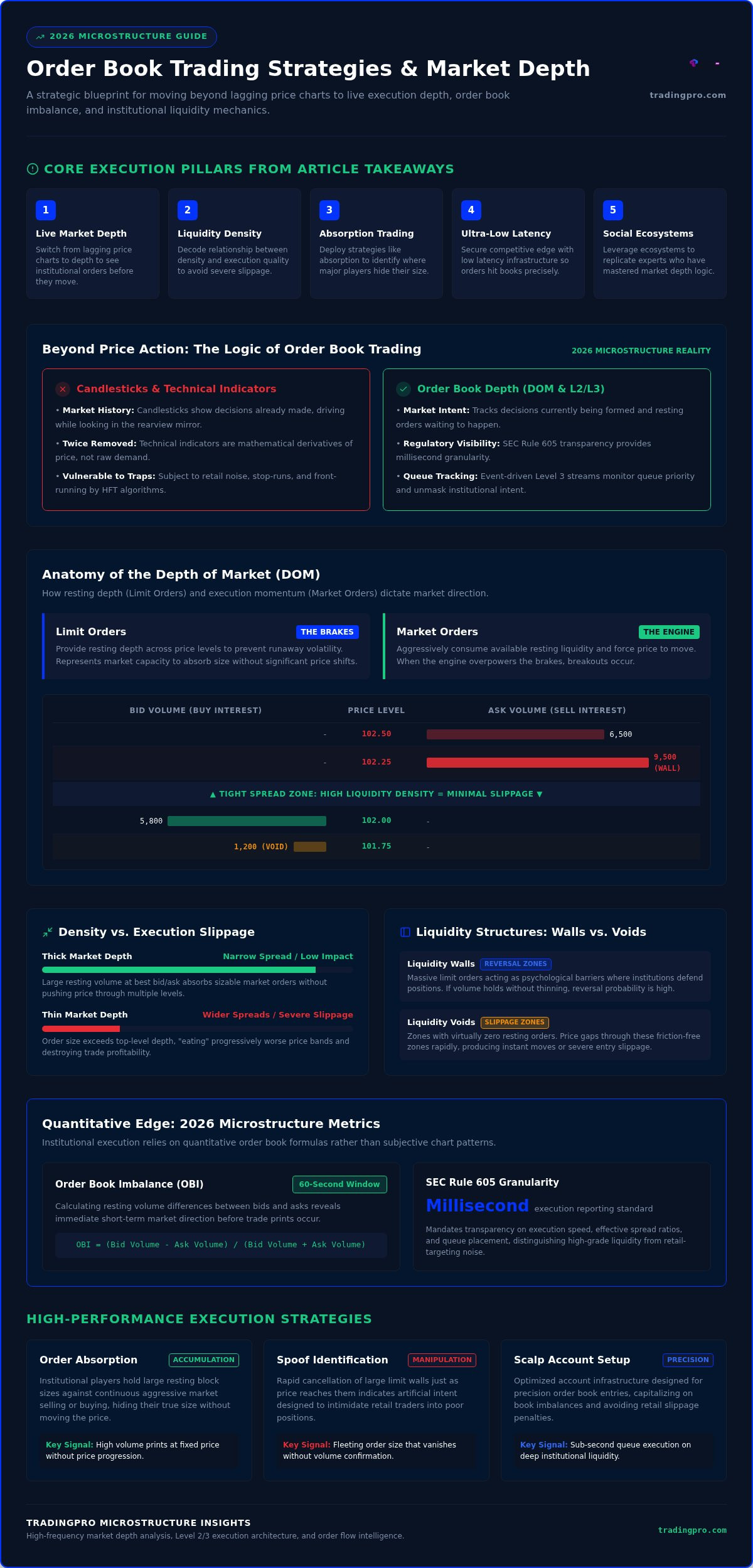
Price action tells you where the market has been. The order book tells you where it's going. In the high-velocity environment of 2026, relying solely on candlesticks is like driving a supercar while looking only at the rearview mirror. You're seeing the result of decisions already made, not the decisions currently being formed. Elite traders have moved beyond lagging indicators to master order book trading strategies that prioritize market intent over historical prints.
The 2026 landscape has evolved. Following the SEC's Rule 605 amendments, execution transparency has reached millisecond granularity. This shift has turned the order book from an optional tool into a mandatory requirement for anyone serious about performance. We're now in the era of event-driven Level 3 streams where tracking individual queue priority is the only way to avoid being "front-run" by high-frequency algorithms. It's about seeing the internal machinery of the market before it prints a single bar on your chart.
Anatomy of the Depth of Market (DOM)
The DOM is your tactical command center. It visualizes the constant battle between the Bid (buy interest) and the Ask (sell interest) in real time. To truly master order book mechanics, you must understand how these columns interact to create price movement. Every tick represents a shift in the balance of power between those willing to wait and those desperate to execute. It's a live map of the financial battlefield.
Liquidity is the thickness of the order book at specific price levels, representing the market's ability to absorb large trades without significant price shifts. Market orders act as the "engine," consuming available liquidity and forcing price to move. Limit orders are the "brakes," providing the resting depth that prevents runaway volatility. Successful order book trading strategies rely on identifying when the engine is overpowering the brakes, allowing you to enter just as the market prepares to break through a level.
Why Level 2 Data is Your Competitive Edge
Technical indicators are mathematical derivatives of price. They're twice removed from reality. Level 2 data allows you to see pending orders before they execute, giving you a "X-ray" view of the market. This foresight lets you anticipate support and resistance levels before they ever appear on a chart. It's the difference between guessing where a floor might be and seeing the actual buy orders waiting to hold the line.
Most retail traders get chopped up by market noise. By analyzing market depth, you can distinguish between "spoof" orders meant to manipulate and high-conviction institutional blocks. Institutions often hide their true size, but they can't hide the impact of their resting orders on the book's overall imbalance. For traders using a Scalp Account, this data is the difference between a precision entry and a costly mistake. It's about mastering Market Intent (the orders waiting to happen) rather than just reacting to Market History.
Decoding Market Depth: Liquidity, Spreads, and Slippage
Understanding liquidity density is the first step in mastering order book trading strategies. It directly determines the "tightness" of the bid-ask spread. When market depth is thick, the gap between what buyers offer and sellers demand stays narrow, offering the most efficient execution environment. As depth thins, spreads widen, and the cost of doing business increases instantly. Professionals don't just look at the current price; they analyze the volume resting at each level to quantify "Price Impact."
Larger position sizes require a deeper understanding of measuring market depth across multiple price bands. If your order size exceeds the volume available at the best bid or ask, you'll experience slippage. You're essentially "eating" through the book, filling your order at progressively worse prices. This is why choosing a partner with deep liquidity pools is non-negotiable for high-performance trading. It ensures your entries and exits remain surgical even during fast-moving market conditions.
Identifying Liquidity Voids and Walls
Liquidity walls are massive limit orders that act as psychological and physical barriers. They often signal where institutional players are defending a position or looking to accumulate. If price approaches a wall and the volume doesn't diminish, a reversal is likely. Conversely, liquidity voids are areas with almost no resting orders. Price tends to gap through these zones rapidly because there's no friction to stop the move. Spotting a wall on your DOM before a breakout allows you to position yourself on the right side of the momentum before the rest of the market reacts.
Calculating Real-Time Execution Risk
Execution risk isn't static. It spikes during high volatility when market makers pull their resting orders, causing the book to "thin" out. You can estimate your potential slippage by looking at the aggregate volume in the top five levels of the book. If the total volume there is less than your intended trade size, you're guaranteed to pay a premium. Protecting your edge requires infrastructure that can handle these shifts without hesitation.
TradingPRO's Scalp Account minimizes execution risk through ultra-low latency. This technical advantage ensures your orders reach the matching engine before the book shifts against you. Mastering these order book trading strategies requires a platform that can keep pace with the market's speed. To start executing with institutional-grade precision, join the elite circle of traders who prioritize depth and speed above all else.
High-Performance Order Book Trading Strategies
Execution is the final frontier where theoretical edge meets realized profit. In the high-stakes environment of 2026, order book trading strategies have evolved into high-precision disciplines that leave traditional technical analysis in the dust. You're no longer just guessing where a trend might go; you're watching the actual fuel for that trend enter the engine. Elite traders use these insights to deploy strategies like "Scalping the Spread," where they capture the micro-gap between the bid and ask by providing liquidity to impatient market participants.
Beyond simple scalping, mastering market depth allows you to identify "Momentum Ignition." This occurs when a surge of aggressive market orders hits the tape, followed immediately by a stacking of limit orders behind the move. It's the signature of a high-conviction trend starting before a single candle has closed. You must also remain vigilant against "Spoofing," where algorithms place massive, fake orders to manipulate retail sentiment. Because order book imbalance carries its strongest predictive value over a window of 100 milliseconds to 60 seconds, your ability to distinguish real intent from digital noise is your most valuable asset.
The Absorption Strategy: Trading with the Giants
Absorption is the ultimate "X-ray" for identifying institutional footprints. It happens when a large player decides to hold a price level, buying every single lot that aggressive sellers throw at them. You'll see high volume printing on the tape, but the price on the DOM refuses to tick down. This "hidden" buyer is absorbing the selling pressure, signaling an imminent reversal once the sellers are exhausted. To trade this, wait for the selling volume to taper off while the bid remains firm. Your exit is clear: if the "wall" finally breaks, the trade is dead. Understanding various order types and execution risks is critical here, as a failed absorption can lead to a rapid liquidity void.
Scalping with the DOM: Speed is the Only Edge
Traditional indicators are too slow for the 2026 scalping environment. When you're operating in the sub-second world, you need to confirm order book intent with "Time and Sales" (the tape). If the DOM shows a heavy ask but the tape is printing large green "buys" that are eating through that depth, the path of least resistance is up. You need tools that can translate this data into action without delay. The TradingPRO Trade Hub provides the one-click execution environment necessary to capitalize on these micro-opportunities. Don't let a slow interface turn a winning read into a losing fill; use a platform built for the speed of modern order flow.
Infrastructure Matters: Execution Speed and Account Tiers
Sophisticated order book trading strategies are useless on a slow platform. You can identify the perfect absorption level or spot a liquidity wall, but if your order takes 300 milliseconds to reach the matching engine, that opportunity is gone. Latency is the silent killer of performance. It turns precision entries into "slippage-induced" losses. In the 2026 market, where institutional desks operate in the 1 to 5 millisecond range, your infrastructure is your edge. You don't just need a good read; you need a fast pipe.
High-volatility order flow trading requires a safety net. This is why we prioritize institutional stability alongside speed. Negative Balance Protection is a core feature of our environment, ensuring your downside is capped even during black swan events or massive liquidity voids. It provides the security you need to trade aggressively without fear of catastrophic debt. Your focus should be on the DOM, not worrying about the "what-if" scenarios of market failure.
Why the Scalp Account is the Standard for Order Flow
Precision requires a specialized environment. The Scalp Account is engineered specifically for traders who need to capture micro-movements with surgical timing. It provides a zero-spread environment, ensuring you don't start every trade in a deficit. Because it utilizes ECN execution, you're seeing "true" market depth, not a filtered retail feed. This direct access allows you to interact with the same liquidity pools used by the industry's dominant forces. It's the professional standard for anyone serious about order flow.
From Rookie to Pro: Scaling Your Infrastructure
Every elite trader starts somewhere. If you're just starting your journey, the Rookie Account offers a stable entry point to learn the mechanics of the book. As your volume increases and your strategy matures, transitioning to institutional-grade tiers becomes a necessity for maintaining your competitive advantage. You can leverage the TradingPRO deposit bonus to bolster your margin, giving you the breathing room needed to manage larger positions as you scale.
Mastering the markets in 2026 requires a blend of education and execution. If you're still building your foundation, our Forex Trading for Beginners Guide is an essential resource. Once you're ready to upgrade your execution and stop letting slippage drain your profits, it's time to step into the big leagues. Open your high-performance account today and experience the difference that institutional-grade infrastructure makes.
Scaling Success: Integrating Order Flow with Social Trading
Mastering market depth takes time, but you don't have to wait years to see institutional results. Social Trading is the ultimate shortcut for those ready to scale. It bridges the gap between individual research and elite execution by allowing you to replicate order book trading strategies from the world's most disciplined performers. Instead of staring at the DOM for ten hours a day, you can leverage the expertise of traders who've already decoded the logic of liquidity walls and absorption zones.
This isn't about blind following. It's about strategic diversification. By integrating copy trading into your portfolio, you can spread your capital across multiple order-book-driven specialists. One might excel at scalping the spread during the London open, while another specializes in identifying institutional absorption in high-volume environments. This multi-strategy approach reduces your reliance on a single market condition and builds a more resilient path to success. You're essentially building your own private hedge fund of order flow experts.
Vetting Order Flow Masters in the Social Ecosystem
Success in the social ecosystem requires a surgical approach to vetting. You aren't looking for lucky streaks; you're looking for execution consistency. Focus on Master Traders who exhibit low drawdown and high execution frequency. These metrics often signal a trader who understands the micro-windows of predictive value found in market depth. Check the Social Feed to see how they handle volatility. A true master remains calm when the book thins out, adjusting their size and timing to avoid the "slippage leakage" that plagues less sophisticated actors.
Stay informed by following the TradingPRO blog for deep dives into top-performing strategies. Understanding the nuance between Social Trading vs Copy Trading is essential for choosing the right automation level for your goals. In the 2026 regulatory landscape, transparency is your best friend. Use it to verify every trade before you commit your capital and ensure your partner's style aligns with your risk tolerance.
Automating Your Order Book Strategy
Automation is the final step in your evolution. Set up your copy trading parameters to mirror institutional-grade execution without the manual lag. Modern platforms have evolved to integrate limit-order matching logic, ensuring that followers don't suffer from the spread widening that once destroyed social trading profits. You can now replicate complex order book trading strategies with the same precision as the lead trader, provided your infrastructure is up to the task.
Manage your risk across a diverse portfolio of specialists. Don't put all your weight on a single scalper; balance your exposure to ensure long-term stability. The tools are ready. The liquidity is waiting. It's time to stop being a spectator and start being a dominant force in the market depth landscape. Join the TradingPRO Elite and Start Trading with Precision Today.
Dominate the Depth: Your Future in High-Precision Trading
Mastering the market's internal mechanics is the only way to stay ahead of the curve in 2026. You've discovered how identifying liquidity walls and absorption zones provides a leading edge that simple price action cannot match. By deploying advanced order book trading strategies, you've moved from reacting to historical data to predicting real-time intent. It's the difference between guessing a direction and seeing the orders that drive it.
Elite performance requires more than just a sharp eye. It demands institutional-grade execution speed and specialized environments like our tailored Scalp and Pro account tiers. Whether you're executing manual scalps with surgical precision or leveraging our global social trading ecosystem to replicate the world's most disciplined experts, your infrastructure must be flawless. You deserve a platform that matches your ambition and protects your capital with institutional stability.
Stop letting slippage and latency erode your hard-earned edge. Open Your TradingPRO Account and Master the Order Book to start trading with the clarity you've been missing. The path to elite status is open. Take the lead now and execute with the absolute confidence of a global market leader.
Frequently Asked Questions
What is the best order book trading strategy for beginners?
Focus on identifying liquidity walls. It's the most visual and logical entry point for those new to order book trading strategies. Beginners should look for large limit orders defending a price level and observe how the market reacts. Starting with a Rookie Account allows you to practice these observations in a stable environment before moving to high-frequency execution. This foundational step ensures you understand the logic of the book without the pressure of institutional-grade speed.
Can I use order book strategies on a mobile device?
You can view market depth on mobile, but it's not the optimal environment for professional execution. Successful order flow trading requires seeing the "Time and Sales" alongside the DOM to confirm intent. While our mobile app provides real-time data, serious traders often use it for monitoring positions while relying on desktop setups for the surgical precision required in high-speed scalping. Precision is difficult on a small screen when milliseconds matter in a fast market.
What is the difference between Level 1 and Level 2 market data?
Level 1 data only shows the current best bid and ask price. Level 2 data, or the Depth of Market, provides an "X-ray" view of all resting limit orders at different price levels. This added transparency is essential for professional strategies because it allows you to see where institutional players are hiding their size before the price actually reaches those levels. It's the difference between seeing a wall and just hitting it blindly during high volatility.
How much capital do I need to start order flow trading?
You can start with a modest deposit, but your account tier should match your capital and goals. A Micro Account is excellent for those starting small, while the Scalp Account is designed for those with the margin to handle high-frequency trades. The key isn't the starting amount, but having enough liquidity to manage the volatility and potential slippage inherent in fast-moving order book environments. Always prioritize risk management over raw capital size for long-term success.
Is order book trading the same as tape reading?
No, they are complementary but distinct. Tape reading involves watching the "Time and Sales" to see actual executed trades, while order book trading focuses on resting limit orders that haven't filled yet. Combining both allows you to see the "intent" (the book) versus the "action" (the tape). This dual-view approach is the foundation of institutional-grade market microstructure analysis. It's how pros confirm that the volume on the book is actually converting into real trades.
Why do some orders disappear from the book before being filled?
This is often "spoofing" or high-frequency algorithms repositioning their liquidity. Algorithms frequently cancel and replace orders in milliseconds to manipulate retail sentiment or find better queue priority. In the 2026 landscape, tracking these cancellations is vital. It helps you distinguish between real institutional commitment and fake orders designed to trap impatient traders into poor entries. Understanding these disappearing orders is the first step in avoiding the noise of the DOM and finding real value.
Do order book strategies work in the Forex market?
Yes, but they require ECN execution to see true market depth. Because Forex is decentralized, you need a broker that aggregates liquidity from multiple providers. Our Scalp and Pro accounts provide this direct access, allowing you to utilize order book trading strategies effectively by seeing the real supply and demand from global liquidity pools. Seeing the aggregate interest across the market is what separates professional forex traders from the retail crowd who only see a single feed.
How does execution speed affect my order book strategy?
Execution speed is the difference between profit and slippage. If your platform has high latency, the liquidity you see on the book might be gone by the time your order reaches the engine. Professional strategies rely on ultra-low latency to hit the specific price levels identified in the DOM. Without institutional-grade speed, even the most accurate market read can result in a losing fill. Speed isn't just a luxury; it's a structural requirement for modern order flow.


