




- Published on: 2026-10-12 10:12:36
Taking a Break from Trading: A Practical Reset Plan

What if the most disciplined move in trading is to step away? Taking a break from trading can feel risky when markets keep moving, open positions need attention, and time away seems like lost experience. But a pause isn’t a verdict on your ability or a guarantee of better results. It’s a planned reset that gives you room to make decisions with intention instead of reacting under pressure.
If you’re worried about missing opportunities, unsure what to do with active positions, or concerned that a break will erase your progress, those concerns deserve a clear plan. You don’t have to choose between trading through every difficult moment and walking away without direction.
This guide will help you define why you’re pausing, plan for open positions, and preserve the routines and lessons you’ve already built. You’ll also learn how to set thoughtful conditions for returning, so your next step is based on readiness rather than FOMO, frustration, or a need to win back losses. A deliberate break keeps the focus where it belongs: on disciplined decision-making.
Key Takeaways
- Use clear prompts, such as difficulty following your routine, to decide whether it’s time to reassess your trading activity.
- Before pausing, review open positions, pending orders, and copy-trading activity so you understand what may continue to affect your account.
- Make taking a break from trading purposeful by defining why you’re stepping away, setting boundaries, and choosing a check-in point that suits your situation.
- Time away can change your routine, but it can’t control market movements or remove risks attached to open positions.
- Return only when you can state your purpose, risk limits, strategy, and ability to follow your rules.
Taking a Break from Trading: When a Pause Can Help
Stepping back from the market can be a deliberate decision, not a sign that you’ve failed. Trading requires attention, consistency, and the ability to follow a plan as conditions change. If your recent choices no longer reflect the approach you intended to take, pausing to reassess can be more purposeful than carrying on by habit.
A trading break is a temporary, intentional pause in trading activity, taken to review your decisions, routines, or goals. It isn’t a promise of better performance, and it doesn’t change what the market does while you’re away. Its value is in creating a defined space to consider your next step.
Your plan matters here. A trading strategy gives structure to your decisions, but even a well-considered approach deserves periodic review. A pause can help you notice whether your actions still match the rules and aims you set for yourself.
Signs that it may be time to pause trading
Look for patterns, not a single result. One losing trade doesn’t, by itself, mean you need a break. Repeatedly entering trades impulsively, ignoring your own criteria, or trading mainly to recover losses can be stronger reasons to stop and reassess. Notice changes in your focus, patience, and confidence without trying to diagnose yourself.
- You find yourself taking trades before checking whether they fit your plan.
- You keep changing rules in response to the latest win or loss.
- You feel driven to trade again quickly to make back a loss.
These are prompts for reflection, not a checklist that can determine what you must do. Compare recent decisions with your written plan. If the gap keeps appearing, consider whether continuing to trade right now serves the purpose you set for yourself.
A break is not the same as giving up
A planned pause has boundaries and a purpose. You’re not necessarily quitting permanently or discarding your trading plan. You’re choosing to step out of active trading for a while and make room to examine your habits, goals, and approach. That distinction makes the pause a considered decision rather than a reaction to one difficult moment.
Be specific about what you want to assess. Are you checking whether your strategy still fits your goals, whether your routine is realistic, or whether you’ve been following your own rules? Write down the questions before stepping away. That gives the pause a clear focus without assuming it will lead to improved results.
Keep the decision personal and evidence-led. A useful pause doesn’t have to follow someone else’s timeline, and returning isn’t an obligation. The next sections explain what needs attention before you step away and how to set conditions for a deliberate return.
What a Trading Break Can and Cannot Change
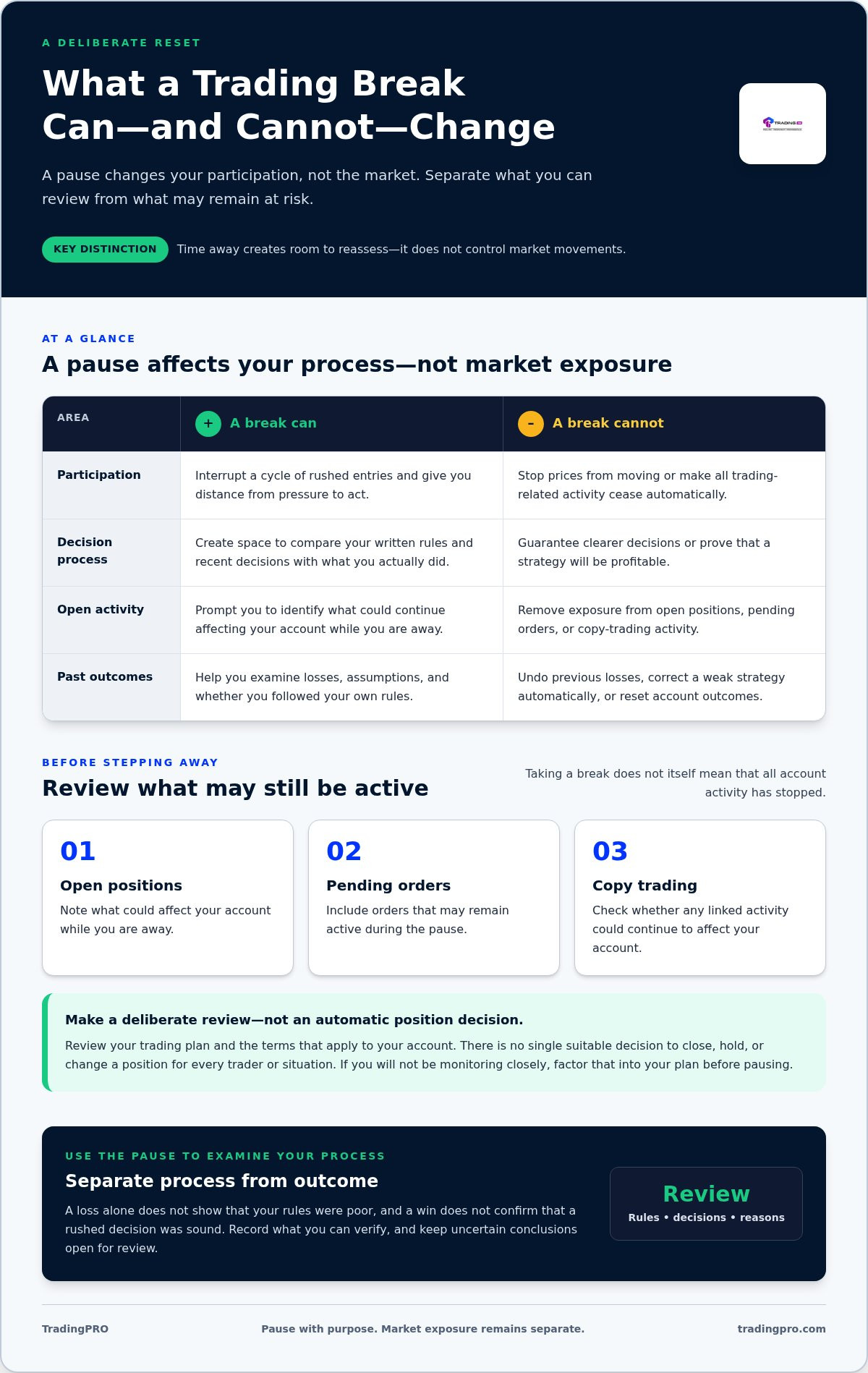
A pause changes your participation, not the market. Stepping away may interrupt a cycle of rushed entries or give you distance from the pressure to act, but prices can continue moving and account exposure can remain. Treat the reset as a chance to review your decisions, not as a way to control what happens while you’re inactive.
Personal recovery time can give you room to reassess, but it doesn’t pause the risks attached to market exposure. That distinction is central to taking a break from trading responsibly. Your routine and decision process are yours to examine. Open positions, pending orders, and account conditions need separate attention.
A pause also won’t automatically resolve previous losses or correct a weak strategy. It can help you look at those issues without placing another trade in the moment, but you’ll still need to evaluate the choices and assumptions behind them. Don’t treat time away as a reset button for account outcomes.
A pause does not remove existing market exposure
Before stepping back, make an inventory of what could remain active: open positions, pending orders, and any activity linked to a copy-trading arrangement. Note what could affect your account while you’re away, then review your trading plan and the terms that apply to your account. There isn’t one suitable position decision for every trader or situation.
This review isn’t a default instruction to close, hold, or change anything. It’s a prompt to make a deliberate choice instead of assuming that taking a break means all activity has stopped. If you won’t be monitoring closely, factor that into your plan before you pause.
A pause can create room for a clearer review
Use the space to examine your written rules, recent decisions, and original reasons for entering trades. Compare what you intended to do with what you actually did. Record observations plainly. For example, “I entered before checking my criteria” is more useful than immediately deciding that your whole strategy has failed.
Keep conclusions measured. A handful of trades may not reveal a reliable pattern, and a journal can help organize your thinking without proving that a method will be profitable. Look for questions to investigate, such as whether you followed your entry rules or changed your risk decisions under pressure. Separate what you can verify from what you’re still unsure about.
As you review, distinguish a process concern from a market outcome. A loss alone doesn’t show that your rules were poor, and a win doesn’t confirm that a rushed decision was sound. That separation helps make the pause useful without turning it into a promise about future results. If your review leads you to reconsider your account setup, TradingPRO’s Rookie, Micro, Pro, and Scalp accounts offer options to evaluate against your needs. When you’re ready to explore a setup, you can review TradingPRO account options.
How to Manage Positions, Orders, and Copy Trading Before a Break
Before taking a break from trading, map out what could remain active in your account. A pause in your routine doesn’t necessarily stop open positions, pending orders, or copied trading activity. Review each category separately, then decide what action fits your plan and account conditions. Don’t assume that stepping away means your exposure has disappeared.
Start with a complete inventory. For every open position, note why you entered, the risks you’re monitoring, and any exit rules or scheduled events that could matter during your absence. For pending orders, ask whether the original setup still matches your current plan. Review the relevant account terms to understand how positions and orders are handled.
Review open positions and pending orders
Some questions need an active decision before you pause. Others can be reviewed in advance, recorded, and revisited when you return. The distinction depends on your strategy, the position, and the conditions that apply to your account. Use this table to structure your review, not as a universal instruction to close, hold, or change anything.
| Activity | Question to review | Action to decide independently |
|---|---|---|
| Open position | What risks, exit rules, or scheduled events could affect it while I’m away? | Decide how to manage it in line with your plan and account terms. |
| Pending order | Does the order still match my current entry criteria? | Decide whether it should remain in place or be handled another way. |
| Copy trading | Could copied activity continue, and what allocation or controls apply? | Review the copied trader and available settings, then decide what fits your pause. |
| Account conditions | Which terms explain how my positions or orders operate? | Read the relevant terms before choosing your next step. |
Check automated and copy-trading activity
Identify any setup that may continue to place or mirror trades while you’re not actively reviewing it. With copy trading, consider which trader you’re following, how much of your account is allocated, and what controls are available in your setup. TradingPRO’s social and copy trading ecosystem lets clients copy experienced market participants, but copying another trader doesn’t remove the need to consider risk or decide whether continued activity fits your plan.
Separate what needs monitoring from what you can review ahead of time. A position with a relevant event approaching may call for a different review than an order that no longer fits your criteria. Copied activity may also need a deliberate decision rather than an assumption that it will stop automatically. You don’t need one universal rule; you need a clear picture of what remains active and a decision for each item.
Before you pause, save your inventory and decisions in one place. That record gives you a concrete reference and helps you avoid relying on memory when you return.
How to Plan a Trading Break Step by Step
A useful reset starts with a plan, not an arbitrary deadline. Decide what you want to step away from, what still needs attention, and what you’ll review before considering a return. Taking a break from trading should fit your circumstances and responsibilities, so set a personal check-in point rather than following a fixed schedule.
- Define the purpose. Name what the pause is for: rest, reviewing your strategy, changing your routine, or addressing another specific need. A clear purpose helps you judge whether the pause is giving you space to consider the right questions. Keep the goal practical, such as identifying where you have departed from your written rules.
- Set boundaries. Decide which activities you’re pausing. Will you stop placing trades, checking prices, or reviewing market commentary? Note anything that still needs attention, such as existing positions or copied activity. Make the boundaries specific enough that you know what stepping away means in your case.
- Review your activity. Before the pause begins, record relevant positions, orders, and trading arrangements, along with any decisions you need to make about them. Then gather your trading notes or journal. The aim is to preserve useful context, not to make a rushed change simply because you’re taking time away.
- Choose a check-in point. Set a date or personal cue to review how the pause is going. Treat it as a chance to reassess, not a deadline to resume trading. Write down what you want to consider at that point, including whether your original reason for pausing has changed and which questions remain unresolved.
Set the purpose and boundaries of the pause
Make your boundaries workable. For example, if you’re pausing new trades but still need to review existing account activity, record that distinction. If you want a break from market screens, decide how you’ll handle essential checks without slipping back into constant monitoring. Let your plan and account conditions guide what remains on your attention list.
Use the pause to review, not to chase a quick fix
Look through your journal for repeated choices, moments when you followed your plan, and points where you departed from it. Write unanswered questions separately from conclusions, especially if your notes cover only a small sample of trades. Learning can be optional and low-pressure. If revisiting the basics would be useful, use this forex trading beginners guide as a reference, not a new performance target.
Keep your pause focused on the questions you chose, rather than trying to solve every trading challenge at once. When you’re ready to review your trading setup and account options, explore TradingPRO account options as one part of that considered reassessment.
When and How to Return to Trading Deliberately
There’s no universal countdown for returning to the market. Use the check-in point in your break plan to review your readiness, not to pressure yourself into placing a trade. Taking a break from trading is a considered reset only if you’re willing to reassess honestly, even if that means extending the pause or changing your plan.
A gradual return can begin without a live trade. Revisit your written strategy, review relevant market information, and make sure you can explain how a potential setup fits your rules. Give yourself room to test your understanding before deciding whether you’re ready to take on market exposure again.
A readiness checklist before placing another trade
Before resuming, answer these questions in your own words. If an answer is unclear, treat that as a reason to review further, not a prompt to rush.
- Purpose: Have you reviewed why you paused, and can you explain what has changed or what you’ve learned?
- Trade rationale: Can you state why a potential trade fits your strategy before acting, rather than inventing a reason afterward?
- Risk limits: Do you know the risk you’re prepared to take and the boundaries you’ve set for yourself?
- Strategy: Can you describe the rules that guide your entry, management, and exit decisions?
- Capacity to follow rules: Are you prepared to stop again if you notice yourself breaking the boundaries in your plan?
Readiness isn’t about feeling certain that a trade will work. It’s about being able to make a decision for a clear reason, understand the risks involved, and follow your own rules regardless of the outcome.
Match the trading setup to the plan
As part of your review, consider whether your current account setup still suits your needs and approach. TradingPRO offers Rookie, Micro, Pro, and Scalp account tiers. You can review the Rookie Account as one option and assess it against your requirements, strategy, and risk limits. An account choice doesn’t replace a trading plan or remove the need to make deliberate decisions.
Keep the first step back measured. You might begin by reviewing your plan and identifying what would qualify as a valid setup, then decide separately whether to place a live trade. Don’t let a busy market, a missed opportunity, or a self-imposed return date make the decision for you. If your checklist isn’t complete, take more time to review.
Once you’ve considered your readiness and account needs, you can register with TradingPRO when you are ready. Make that choice on your own terms, with a clear plan in hand.
Make Your Next Trading Decision on Your Terms
The strongest next step may be returning, adjusting your approach, or choosing to wait. Let that decision come from your own readiness and the plan you’ve reviewed, not pressure to catch up with the market. Taking a break from trading is most useful when it leaves you more intentional about what you’ll do next, whatever that decision turns out to be.
If you’ve decided you’re ready to move forward, take that step with your goals and risk boundaries clearly in view. Register with TradingPRO when you are ready, and keep your decisions grounded in a plan you can follow. You’re in control of the pace. Move forward with purpose.
Frequently Asked Questions
Should I stop trading after a loss?
Not automatically. One loss is part of a trade’s outcome, not enough on its own to judge your whole approach. First, compare the trade with the rules you set before entering it. If you followed them, record the result and avoid changing your process solely to erase the loss. If you feel compelled to trade again immediately or increase risk to recover, step back before making another decision.
How long should I take a break from trading?
There’s no fixed duration that suits every trader. Set a review point based on your reason for pausing, then assess whether the issue you identified has changed. For example, if you stepped away to review a strategy, return to that review when you can evaluate it calmly, not simply when a chosen number of days has passed. A check-in is a prompt to reassess, not a deadline to trade.
Can I leave open trades running while I take a break?
Possibly, but understand what could happen to each position while you’re away before deciding. Review the position’s planned exit, the conditions that might affect it, and the relevant account terms. For example, a position tied to a scheduled market event may need a different level of attention from one without a near-term event. Don’t assume a pause in new trading activity removes the exposure of trades already open.
What should I do with pending orders before stepping away from trading?
Review every pending order against the reason you placed it. If the market setup or your criteria have changed, decide whether leaving it active still fits your plan. Check the order details and account terms so you understand how it may be handled. Keep a brief note of your decision and why you made it. That record can help prevent an old order from being mistaken for a fresh trading idea later.
How do I know when I am ready to start trading again?
You’re better prepared to consider returning when you can explain a potential trade’s rationale, planned risk, and exit conditions before acting. Check whether you can follow those rules without feeling pressured to make back lost time or money. A practical test is to review a hypothetical setup on paper first. If you can’t assess it consistently or stick to your boundaries, continue reviewing rather than treating market activity as a signal to resume.
Does taking a break from trading mean I have failed?
No. Taking a break from trading can be a deliberate choice to reassess how your actions align with your goals; it doesn’t define your ability or decide what you must do next. Use the time to consider whether trading still fits your priorities and what conditions you would want before returning. You may resume, revise your approach, or choose not to trade for now. None of those choices is a verdict on your worth.
Should I pause copy trading while I am away from the markets?
Review how your copy-trading setup behaves and decide whether ongoing activity fits the purpose of your break. Consider who you’re copying, the allocation you’ve chosen, and which controls are available in your account. Don’t assume copied trades stop simply because you’ve stopped placing trades yourself. Review your setup details and applicable account terms so you understand what may continue, then make a decision that matches your own risk boundaries.


