




- Published on: 2026-08-04 06:01:51
Why Milliseconds Matter: A Guide to High Speed Execution Brokers in 2026

Your strategy isn't the bottleneck; your infrastructure is. You've felt the sting of a perfect entry evaporating into a requote or watching a winning trade turn into a loss because of a 50-millisecond delay. It's frustrating to play by the rules and still lose to the lag. You know that in a 2026 market environment where old regulatory barriers like the Pattern Day Trader rule have vanished, the only real limit on your success is how fast you can hit the tape.
Partnering with a high speed execution broker is no longer a luxury for elite firms. It's the fundamental layer of risk management that separates profitable scalpers from the rest of the pack. This guide shows you how to eliminate the slippage tax and harness millisecond precision as your ultimate competitive edge. We will explore the shift toward modern risk-based margin systems, the power of the latest FIX protocol updates, and how to access the institutional-grade infrastructure required to execute large orders with zero hesitation.
Key Takeaways
- Understand why the 30-millisecond execution standard is the new baseline for profitability in the 2026 trading landscape.
- Learn how server proximity to global hubs like Equinix LD4 enables a high speed execution broker to minimize physical latency and requotes.
- Calculate your "slippage tax" to see how minor execution delays can silently drain thousands from your yearly profit targets.
- Master technical audit steps, such as ping tests and order-to-fill log monitoring, to verify your platform’s true performance.
- Scale your strategy using institutional-grade infrastructure designed specifically for high-frequency needs and precision entries.
What is a High Speed Execution Broker and Why Does It Matter?
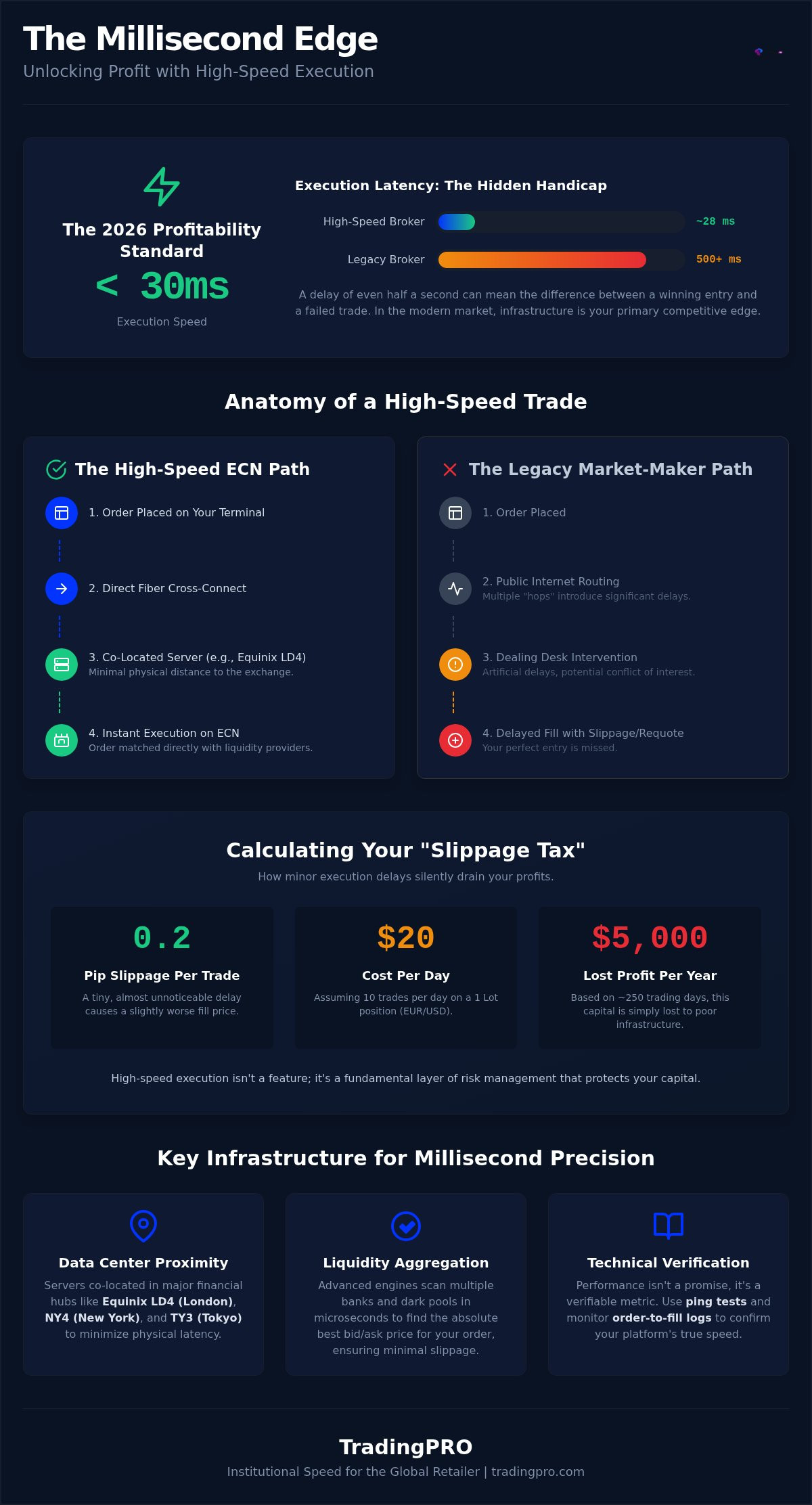
In the high-stakes environment of 2026, a high speed execution broker is defined by a single, uncompromising standard: the ability to fill orders in under 30 milliseconds. The days of measuring trade speed in seconds are over. In a market where price action moves with lightning intensity, a delay of even half a second is the difference between a winning entry and a failed trade. This shift toward millisecond precision has transformed trading from a game of direction into a game of infrastructure. If your broker isn't utilizing low-latency technology, you're essentially trading with a handicap.
This technical edge is vital for both manual traders and algorithmic bots. While a bot requires speed to capitalize on fleeting arbitrage opportunities, a manual trader needs it for psychological certainty. Instant fills eliminate the "execution anxiety" that comes from watching a price tick away while your order sits in a queue. When you see a price, you deserve to get that price. Elite infrastructure ensures that your intent matches the market reality with zero hesitation.
The Evolution of Trading Speed
The journey from the shouting matches of physical trading floors to the silent hum of fiber-optic cables represents a relentless pursuit of efficiency. By 2026, market volatility has become so compressed that legacy brokers relying on outdated routing have become obsolete. Modern speed is driven by Electronic Communication Networks (ECNs) that match orders directly without human intervention. This institutional-grade framework was once reserved for High-frequency trading firms, but it's now the standard for any serious retail participant. Today, the ECN model provides the transparency and velocity required to navigate global liquidity pools without the interference of a dealing desk.
Speed as a Component of Risk Management
Slow execution is a hidden risk factor that quietly erodes your capital. Execution latency is the time elapsed between order submission and market confirmation. When latency is high, your stop-losses are at risk of "gapping" during volatile news events, meaning you could be filled at a much worse price than your strategy dictates. High-speed environments act as a shield for your capital. By ensuring your orders hit the market instantly, you maintain tighter control over your exits and protect your profit targets. For those utilizing the Scalp Account, this precision isn't just a feature; it's the primary defense against market noise. You don't just need a broker; you need a partner that values your time as much as your capital.
The Anatomy of High-Speed Infrastructure
High speed execution is not a marketing myth. It is the direct result of physical hardware, elite server placement, and optimized routing. A true high speed execution broker doesn't just promise velocity; they invest in the heavy iron required to deliver it. While legacy brokers route your orders through congested public internet channels, institutional-grade providers use dedicated fiber-optic cross-connects. These physical cables connect the broker's server directly to the liquidity provider's engine. This eliminates the "hops" that slow down your data, ensuring your trade arrives at the global pool before the price can shift.
Liquidity aggregation engines act as the brain of this operation. In microseconds, these engines scan multiple banks and dark pools to find the absolute best bid and ask price. This process happens so fast that it feels instantaneous to the human eye. By the time you click "Buy," the engine has already mapped the most efficient path to fill your order at your requested price. This is how high-speed infrastructure eliminates the "slippage tax" that quietly drains retail capital.
Data Centers and Latency
Physical distance is the enemy of speed. If your broker's server is in a remote location while the exchange is in London, your order must travel thousands of miles. This creates "ping" time that kills scalping strategies. To dominate the 2026 market, you need servers located within elite data centers like Equinix LD4 (London), NY4 (New York), or TY3 (Tokyo). These hubs house the world's largest financial exchanges. TradingPRO prioritizes these locations for its Scalp Account, placing your terminal in the same room as the world's biggest liquidity providers. The result is a frictionless experience where your trade intent becomes market reality in under 30 milliseconds.
ECN vs. Market Makers: The Speed Divide
The internal structure of your broker determines your ultimate success. Market makers, often called B-Book brokers, often benefit from your losses. They may create artificial delays or requotes because they need time to decide whether to take the other side of your trade. This conflict of interest is a massive speed barrier. In contrast, the No-Dealing Desk (NDD) and ECN model provides a clear, frictionless path. The debate regarding Fairness in Financial Markets often centers on access to this very technology. Professional scalpers avoid B-Book brokers because they cannot afford the hidden cost of manual intervention. You deserve a partner that acts as a bridge, not a gatekeeper. You can secure your institutional-grade access and start trading on a level playing field today.
Calculating the 'Slippage Tax': How Speed Saves Money
Slippage is the silent killer of retail capital. It represents the gap between your requested price and the actual fill price. While many traders accept this as an unavoidable market condition, it is actually a "slippage tax" imposed by inferior technology. A high speed execution broker eliminates this drain by ensuring your order hits the liquidity pool before the price can shift. In a market moving at the speed of 2026, waiting even 100 milliseconds is an invitation for the market to move against you.
The math behind this tax is devastating. If you trade five lots and consistently lose just 0.5 pips to slippage, you are throwing away a significant portion of your edge every day. Over 1,000 trades, that 0.5-pip leak can completely destroy a yearly profit target. High-speed execution is the only cure for this negative drift. In fact, elite infrastructure can occasionally provide positive slippage. This happens when the broker's aggregation engine finds a superior price in the microseconds after your order is sent, actually improving your entry price beyond what you requested.
The Impact on Scalping and Day Trading
Precision is everything when your profit targets are tight. A strategy aiming for a 5-pip target simply cannot survive a 1-pip execution lag. That 20% erosion of your potential gain makes long-term success impossible. The compounding effect of execution efficiency over thousands of trades is what separates elite performers from the rest. To stay competitive, you must utilize the Best Trading Infrastructure for Scalping. Consistency in your fill price leads directly to consistency in your equity growth curve.
Requotes: The Ultimate Momentum Killer
"Price has changed." This is the most expensive message a trader can receive. Requotes occur when a broker cannot fill your order at the requested price and demands you accept a worse one. This friction usually peaks during high volatility, exactly when your strategy needs to be most responsive. High-speed brokers eliminate these interruptions by leveraging deep liquidity and instant routing. Regulatory bodies remind us that brokers have a duty to seek the best execution, which inherently includes minimizing these delays. Fill reliability depends on a direct path to the global pool. When that path is optimized for millisecond precision, requotes become a relic of the past.
How to Test and Optimize Your Execution Speed
You cannot manage what you do not measure. Stop guessing about your performance and start auditing your environment. A legitimate high speed execution broker provides the transparency you need to verify their claims through hard data. If your broker hides their execution logs or provides vague averages, they are likely masking infrastructure weaknesses. To dominate the 2026 markets, you must take control of your technical setup and optimize every link in the chain.
Follow these five steps to audit your current execution environment:
- Step 1: Run a 'Ping' test from your terminal. This measures the round-trip time for data to travel from your computer to the broker's server. Aim for under 10ms for professional results.
- Step 2: Audit your platform logs. Look for the 'Order-to-Fill' timestamp. This reveals exactly how long the broker took to process your request after receiving it.
- Step 3: Deploy a VPS. Physical distance is a speed killer. Placing your terminal on a server in the same data center as your broker is the single most effective way to slash latency.
- Step 4: Review your 30-day slippage stats. Calculate the average difference between your clicked price and your fill price. If this number is consistently negative, your infrastructure is leaking capital.
- Step 5: Compare account tiers. Often, elite tiers like the Scalp Account utilize different routing logic than entry-level accounts. Test both to see the difference in fill quality.
The Role of the Trading VPS
Your home internet connection is not built for high-performance trading. Standard fiber or cable connections often have latencies ranging from 30ms to 100ms. By using a Virtual Private Server (VPS) located near the broker's hub, you can reduce this to a staggering 1ms. This ensures your automated strategies stay connected 24/7 without the risk of local power outages or ISP throttling. TradingPRO's Trade Hub is designed to assist you in monitoring this performance, giving you a real-time view of your execution health. You need institutional-grade connectivity to compete with institutional-grade players.
Order Types and Execution Logic
The type of order you use dictates how the broker's engine handles your request. Market orders prioritize speed, filling you at the best available price instantly. Limit orders prioritize price, but they risk not being filled if the market moves too fast. For those who demand precision, 'Fill or Kill' (FOK) orders are essential. An FOK order ensures your trade is either executed entirely at your price or cancelled immediately. This prevents partial fills that can leave your position exposed. Master these settings in your terminal to set maximum slippage parameters and protect your entries. You can register your professional account now to begin optimizing your execution logic with elite tools.
TradingPRO: Institutional Speed for the Global Retailer
Your search for the ultimate competitive edge ends here. TradingPRO operates as a dominant high speed execution broker, providing the technical foundation you need to dominate the 2026 markets. We don't just offer access; we offer empowerment. By bridging the gap between retail capital and institutional-grade infrastructure, we ensure your strategy is never limited by your environment. Experience the power of a platform built for peak performance. We act as your expert guide, providing the tools and the confidence required to excel in a fast-moving landscape.
The Scalp Account is our flagship solution for millisecond precision. It utilizes direct market access to connect you with premier liquidity providers, bypassing the delays inherent in traditional retail models. Our zero-requote policy is a core promise. Even during extreme volatility, your entries remain frictionless. We provide a safe-haven environment that combines high-octane speed with the rock-solid stability of a global leader. Our infrastructure is designed to handle large orders with minimal slippage, ensuring that retail traders have the same advantages as the biggest firms in the world.
Tailored Accounts for Every Speed Requirement
Every trader's journey is unique. Whether you are starting with a Rookie Account or scaling into professional high-frequency strategies, our multi-tier structure supports your growth. You'll never outgrow your broker. As your capital increases and your execution needs evolve, our accounts scale with you. Our Pro and Scalp tiers are specifically engineered for those who demand the fastest possible round-trip times. This flexibility is backed by years of excellence and a commitment to institutional stability that protects your assets while you pursue significant goals.
Your Journey to High-Performance Trading Starts Here
2026 is the year to leave legacy infrastructure behind. The removal of outdated regulatory hurdles has opened the door for a new era of trading velocity. We are proud to empower traders in emerging markets with world-class technology that was once out of reach. Our global reach ensures that whether you're trading from a major financial hub or a growing economy, your connection to the markets is frictionless. Don't let a slow fill be the reason you miss your targets. Secure your edge today and trade with the confidence of an institutional player. Register your account now and experience what millisecond precision actually feels like.
Secure Your Competitive Edge in the 2026 Markets
You've seen the math. Slippage isn't just a market condition; it's a silent tax on your ambition. In a 2026 landscape where volatility moves at lightning speed, your infrastructure is your most vital risk management tool. By positioning your terminal within elite data centers in London and New York, you transform your trading from a game of chance into a display of precision. Auditing your ping and monitoring your fill logs are no longer optional steps. They are the requirements for anyone serious about retail capital growth.
TradingPRO stands as the definitive high speed execution broker for those who refuse to settle for legacy delays. We bring over 7 years of institutional-grade brokerage experience to your screen, ensuring every trade hits the tape with zero hesitation. Our Scalp Account is specifically optimized for sub-30ms execution, providing a frictionless path to your profit targets. Don't let lag dictate your success. It's time to trade with the authority of a global leader.
Claim Your High-Speed Edge: Register with TradingPRO
The market waits for no one. Take command of your execution today and experience the confidence that comes with institutional-grade performance.
Frequently Asked Questions
What is a good execution speed for a forex broker?
In 2026, professional trading standards require execution speeds under 50ms. Elite scalping brokers push this benchmark even further, targeting sub-30ms execution to handle high-velocity market shifts. If your fills consistently exceed 100ms, you're trading with a significant technical disadvantage. Choosing a high speed execution broker ensures that your orders hit the liquidity pool before the price can move against your strategy.
Does execution speed affect slippage?
Velocity is the primary cure for negative slippage. The faster your broker processes an order, the less time the market has to fluctuate away from your requested price. This precision is vital during news events when price action is most aggressive. Rapid execution ensures your trade intent matches the market reality, protecting your profit margins from the silent drain of execution lag and infrastructure friction.
Is a VPS necessary for high-speed trading?
A VPS is essential for traders who demand institutional-grade performance. While not strictly mandatory for every strategy, it eliminates "last-mile" latency by placing your terminal inches away from the broker's server. This setup is a requirement for scalpers and Expert Advisors (EAs). It provides a stable, 24/7 environment that home internet connections simply cannot match, ensuring you stay connected to the tape at all times.
Can I get high-speed execution on a beginner account?
You can access world-class technology regardless of your capital size. TradingPRO provides institutional-grade infrastructure across all account tiers, including our Rookie and Micro options. However, for those who prioritize maximum velocity, our Scalp account is specifically engineered for sub-30ms precision. This ensures that even retail traders have access to the same tools used by professional firms to dominate the global markets.
What causes broker requotes?
Requotes are the direct result of infrastructure failure or liquidity gaps. They occur when a broker cannot fill your order at the requested price and demands you accept a new, often worse, one. This usually happens because of slow execution speeds or a lack of deep liquidity during volatile moves. Choosing a high speed execution broker with direct market access eliminates these momentum-killing interruptions and ensures frictionless entries.
How do I check my latency in MetaTrader?
Monitoring your performance is simple within the terminal. You can check your latency by clicking the connection bars in the bottom right corner of MetaTrader. This displays your "ping" in milliseconds, showing the time it takes for data to travel to the server. Consistent monitoring allows you to verify that your broker is delivering the performance required for your strategy and identify any local connection issues.
Why is ECN better for speed than Market Makers?
ECN brokers offer a frictionless path to the global liquidity pool. Unlike Market Makers, who route orders through a dealing desk "check," an ECN broker passes your trade directly to the market. This removes the manual delay and conflict of interest that often lead to requotes. For active traders, this direct path is the only way to ensure institutional-level execution velocity and transparent pricing.
Does high speed execution cost more?
Performance-driven execution is often more cost-effective for active participants. While high-speed brokers typically charge a small commission, they offer much tighter spreads than standard models. In our Scalp account, this structure results in lower overall trading costs for high-volume strategies. You pay for precision, but you save by avoiding the wide spreads and hidden slippage common with legacy, slow-fill brokers.


