



- Published on: 2026-03-03 17:00:00
Poor Understanding of Market Structure: What Most Traders Miss About Price Movement
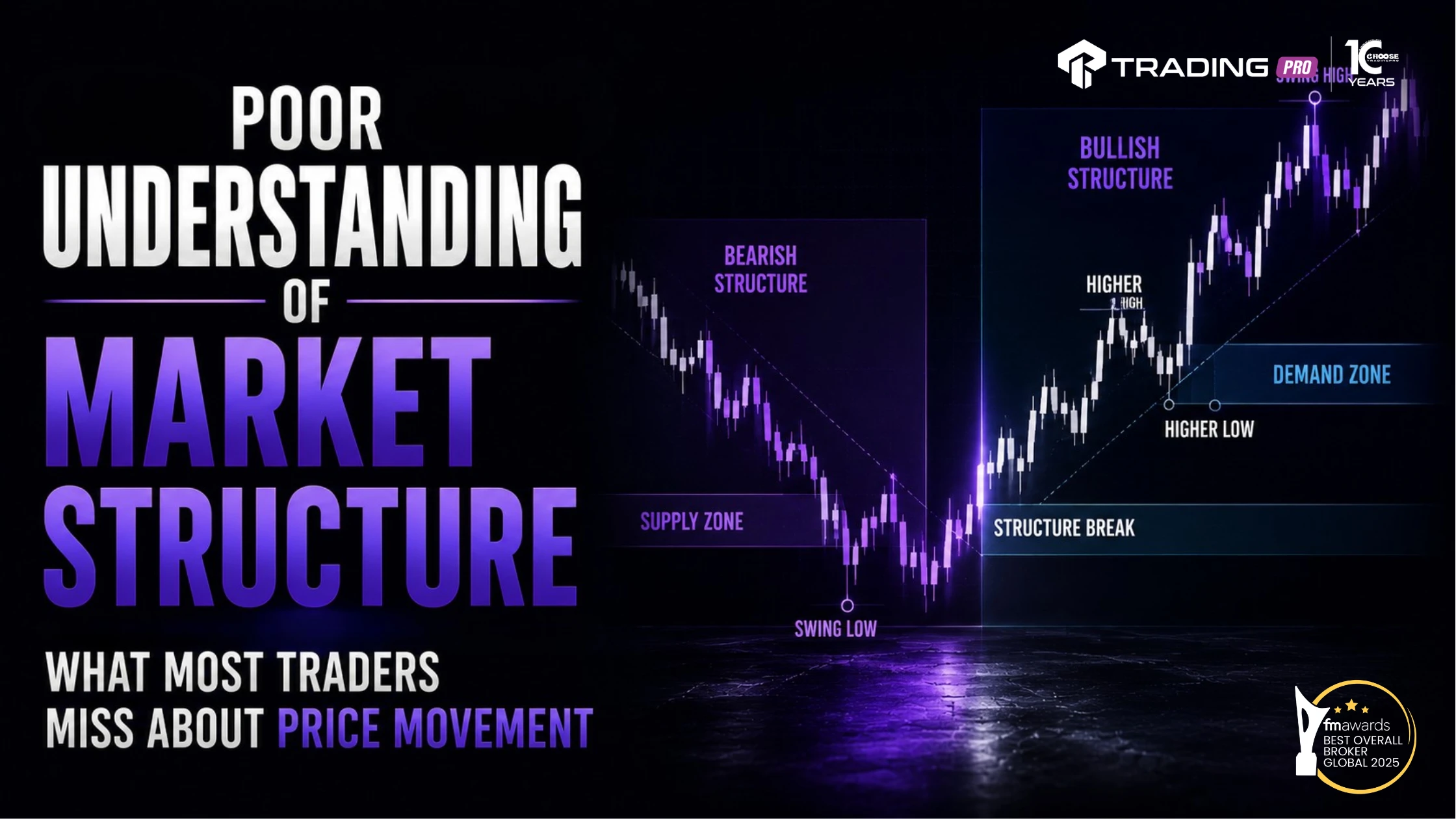
After several years of trading the forex market, one pattern becomes impossible to ignore: most struggling traders do not have a strategy problem. They have a market structure problem. A poor understanding of market structure is one of the single biggest reasons retail traders consistently lose money in forex trading — and it is one of the least discussed.
Market structure is the foundation of price action. It tells you whether the market is trending, ranging, accumulating, or distributing. Without that understanding, traders enter positions blindly — buying at resistance, selling at support, and wondering why their otherwise sound setups keep failing.

What Is Market Structure in Forex Trading?
In straightforward terms, market structure refers to the observable pattern that price leaves behind as it moves. An uptrend is characterised by a sequence of higher highs and higher lows. A downtrend produces lower highs and lower lows. When neither pattern is clearly present, the market is typically consolidating within a defined range — and the rules of engagement change entirely.
Understanding this framework is essential when trading major currency pairs such as EUR/USD, GBP/USD, and USD/JPY. If the higher timeframe is showing a clear bullish trend, taking short positions on lower timeframes significantly — and unnecessarily — reduces your probability of success. You are not finding an edge against the trend. You are fighting the dominant order flow.
This is precisely why professional forex traders always begin with top-down analysis — reading the daily and four-hour charts first to establish the structural context, before ever dropping to lower timeframes to refine an entry.
The Real Cost of Ignoring Market Structure
When traders operate without a clear read on market structure, the consequences show up consistently and predictably. They trade against the prevailing trend, enter during consolidation without structural confirmation, misidentify breakouts as reversals and reversals as breakouts, and place stop-loss orders directly into obvious liquidity zones where price is likely to sweep before continuing.
The result is a familiar cycle: frequent stop-outs, mounting frustration, and emotional decision-making that compounds the losses. A breakout trade taken without confirming a genuine structural shift — such as a clean break and retest of a key level — will more often than not resolve as a false breakout. The trader blames the setup. The real issue is the missing structural context around it.
Market Structure and Risk Management
One of the most underappreciated benefits of understanding market structure is the direct improvement it delivers to risk management. When you trade in the direction of the prevailing trend, you increase the statistical likelihood of continuation in your favour. More importantly, it allows you to place stop-losses logically — beneath a confirmed higher low in an uptrend, or above a confirmed lower high in a downtrend — rather than placing them arbitrarily based on a fixed pip distance.
When market structure analysis is combined with well-defined support and resistance levels, supply and demand zones, and awareness of key economic data releases, the quality of setups improves markedly. You are no longer entering trades based on isolated signals. You are entering with the full weight of context behind every decision.
Final Thoughts
Forex trading is not about predicting what the market will do next. It is about accurately interpreting what price is already doing and positioning yourself in alignment with it. Market structure provides that clarity. It is the lens through which everything else indicators, patterns, entries, and exits should be filtered.
Before entering any trade, ask yourself two questions: Is the market currently trending or ranging? And am I trading with the structure or against it?
Mastering market structure does not just improve your win rate. It transforms trading from an exercise in guesswork into a process of strategic, evidence-based execution. And that is precisely where consistency begins.
Stop guessing price direction and learn to read what the market is already telling you.
Join the TradingPRO community and get access to daily market analysis, trading psychology guides, and strategy breakdowns
Facebook | Instagram | Telegram | LinkedIn | Twitter (X)


