



- Published on: 2026-03-02 18:00:00
The Impact of Probability in Forex Trading
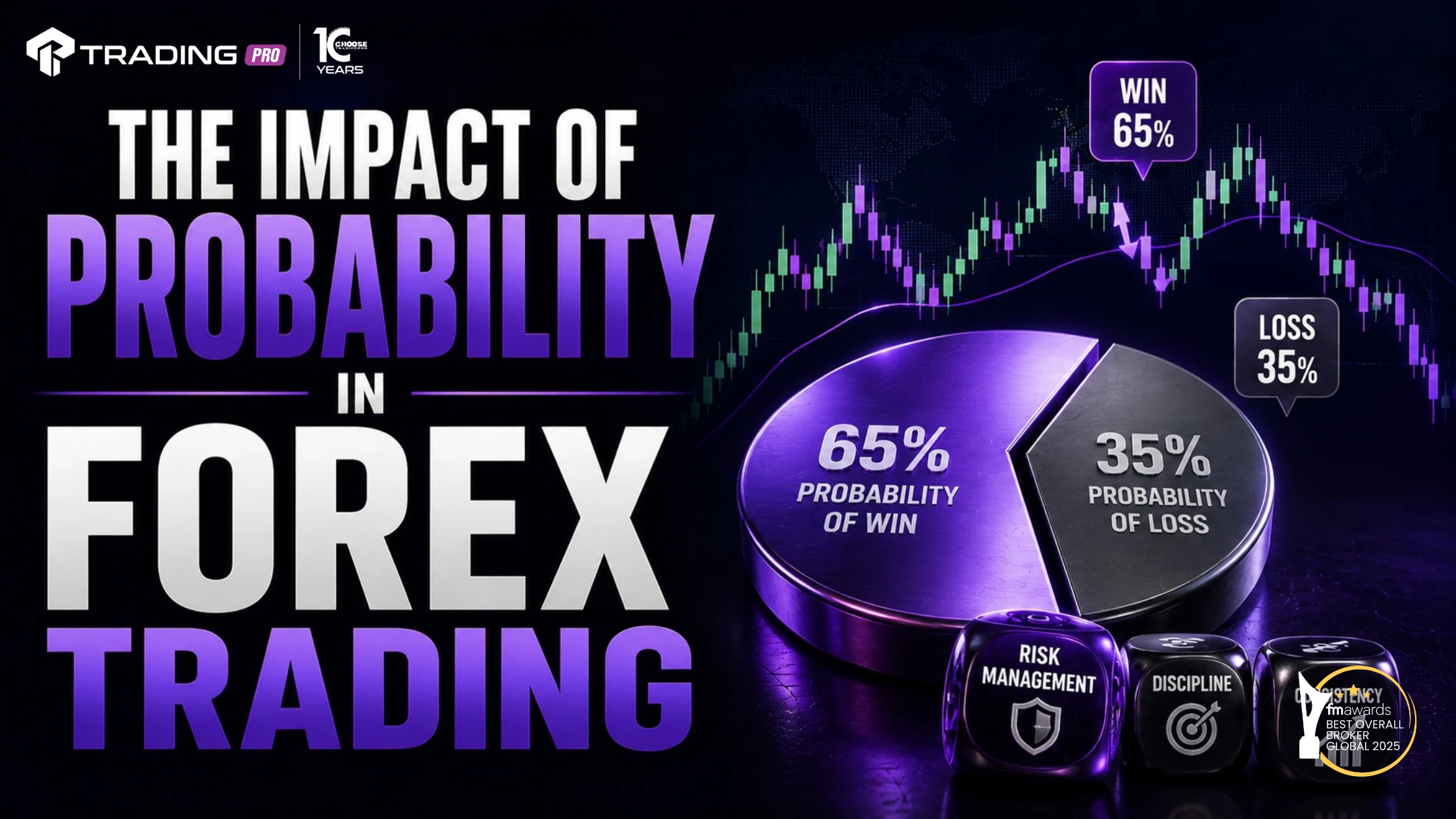
One of the biggest misconceptions in forex trading is that the market can be predicted with certainty. Many beginners invest months searching for a perfect strategy — one with no losses, no drawdowns, and a guaranteed outcome on every trade. But the truth is this: forex trading is a game of probability, not certainty. The sooner that reality is accepted, the sooner everything else begins to make sense.
Embracing probability as the foundation of your trading approach does not just change your mindset — it changes your results.
What Is Probability in Forex Trading?
Probability refers to the statistical likelihood of a given outcome occurring. In trading, it means the measurable chance that any given setup will result in a profitable trade — not on one occasion, but consistently over a large sample of trades.
Consider a strategy with the following characteristics:
- A 60% win rate
- A 1:2 risk-to-reward ratio
- A demonstrated positive edge over 100 trades
This does not mean every trade will win. It means that over a sufficiently large sample size, the strategy produces a positive expectation — and that expectation, compounded consistently, is where profitability lives.
Professional traders think in probabilities, not predictions. That distinction is everything.
Why No Strategy Wins 100% of the Time
The forex market is a living, constantly evolving environment influenced by forces that no system can fully anticipate:
- Economic data releases and revisions
- Central bank decisions and forward guidance
- Geopolitical developments and global risk events
- Sudden shifts in institutional positioning and market sentiment
Because of these variables, no strategy — regardless of how refined or backtested — can guarantee a winning outcome on every trade. Even the most robust systems experience losing runs and drawdown periods. That is not a flaw. It is an inherent feature of operating within a probabilistic environment.
Losses are not a sign that your strategy is broken. They are simply part of the natural probability distribution of any trading edge. The goal is never to eliminate losses — it is to ensure that, over time, your wins outweigh them in both frequency and magnitude.
The Power of Risk-to-Reward and Expectancy
Probability does not operate in isolation. It works in direct combination with risk management — and understanding that relationship is what transforms a theoretical edge into real, sustainable profitability.
Consider this example: a strategy that wins only 50% of the time can still be consistently profitable if it risks 1% per trade while targeting a 2% gain on winners. Even with half of all trades closing at a loss, the mathematics work in the trader's favour over time. This is the concept of positive expectancy — and it is the foundation on which every professional trading operation is built.
Your edge in forex trading is derived from three interconnected elements: a statistical advantage embedded in your strategy, disciplined risk management on every trade, and consistent execution without emotional interference. Remove any one of the three and the edge deteriorates, regardless of how strong the other two are.
Thinking in Series, Not Single Trades
One of the most important — and most difficult — mindset shifts in trading is learning to detach from individual trade outcomes. One trade does not define your edge. One loss does not invalidate your system. One win does not confirm it.
What matters is the series:
- The next 20 trades
- The next 50 trades
- The next 100 trades
Probability only reveals itself meaningfully over a large sample of executions. A trader who abandons their strategy after two consecutive losses is not making a statistical judgment — they are making an emotional one. The sample size is far too small to draw any meaningful conclusion, and reacting to it as though it leads to the kind of strategy-hopping that prevents any edge from ever compounding.
Successful traders accept short-term uncertainty as the price of long-term consistency. They understand that discomfort is not a signal to change course — it is often a signal to stay it.
How to Apply Probability in Your Trading
Shifting from a prediction-based mindset to a probability-based one requires deliberate habits and structured practice:
- Backtest your strategy across a meaningful historical sample before trading it live understand its win rate, drawdown profile, and expectancy
- Use fixed risk per trade — consistent position sizing is what allows the edge to express itself over time without a single trade causing irreparable damage
- Avoid emotional decision-making — decisions made in the heat of a losing streak or a winning run are almost never statistically sound
- Track your performance rigorously — a trading journal reveals whether results are consistent with your strategy's expected distribution, or whether execution is the variable letting you down
- Accept losses with composure — a loss within the expected distribution of your strategy is not a problem to solve; it is simply the cost of doing business
When you stop trying to predict the market and start managing probability with discipline, trading becomes a fundamentally different experience — more structured, more objective, and considerably less stressful.
Stop predicting. Start managing probability and watch your consistency improve.
Join the TradingPRO community and get access to daily market analysis, trading psychology guides, and strategy breakdowns for free.
Facebook | Instagram | Telegram | LinkedIn | Twitter (X)


